A Mixed Start for the Market’s Most Influential Tech Stocks
America’s most powerful technology companies—often referred to as the “Magnificent 7”—have dominated stock market performance for years, driving index-level gains and shaping investor sentiment. However, as 2026 gets underway, the group’s momentum appears far less uniform, raising questions about whether their era of near-constant outperformance can continue.
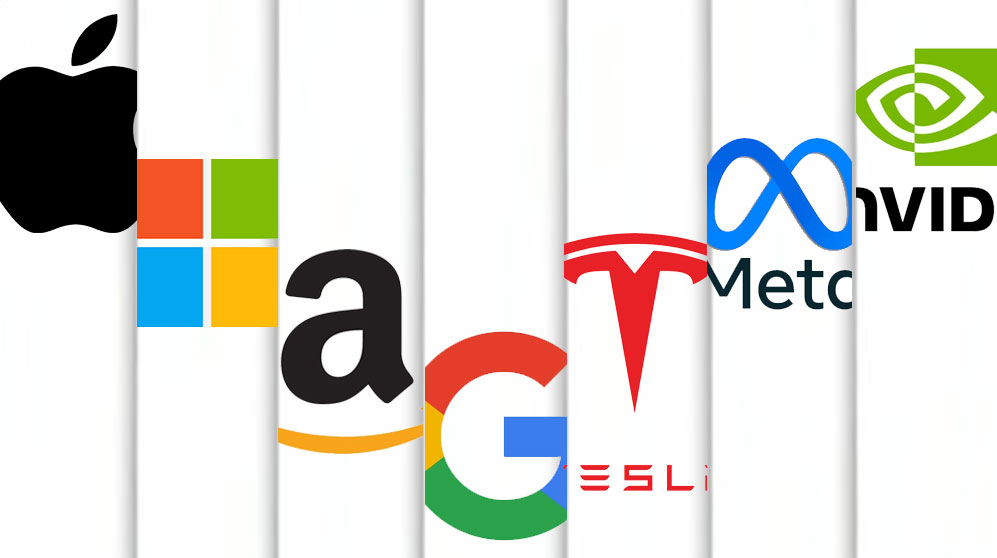
The Magnificent 7—Alphabet, Amazon, Apple, Microsoft, Meta, Nvidia, and Tesla—collectively accounted for more than 40% of the S&P 500’s total return in 2025. Their influence is difficult to overstate: together, they represent roughly one-third of the index’s total market capitalization. But early trading in 2026 suggests that investors are becoming more selective, rewarding some names while pulling back from others.
Alphabet and Amazon have posted modest gains since the start of the year, while Tesla, Meta, and Nvidia are largely flat. Microsoft and Apple, meanwhile, have slipped into negative territory. Reflecting this divergence, the Roundhill Magnificent Seven ETF, which tracks the group as a whole, is hovering near unchanged levels.
As earnings season begins, investors are looking for clarity. The upcoming reports may offer insight into how each company plans to navigate slowing growth, heavy capital expenditures, and growing scrutiny around artificial intelligence investments.
Why the Magnificent 7 Still Matter to Every Investor
Even investors who do not directly own shares of the Magnificent 7 are exposed to their performance. Because of their massive weightings in major equity benchmarks, these companies influence index funds, retirement portfolios, and broad-market ETFs.
When the Magnificent 7 rise together, they can lift the entire market. When they falter—or diverge—the effects ripple across portfolios. This dynamic has become especially important as market leadership narrows, with fewer stocks driving a disproportionate share of gains.
The mixed start to 2026 reflects a broader shift in investor behavior. Earlier this month, geopolitical tensions triggered a more cautious, “risk-off” stance across markets. At the same time, concerns about a potential AI investment bubble have resurfaced, prompting investors to reassess valuations and future growth assumptions.
Unlike previous years, the divergence among the Magnificent 7 suggests that investors are no longer treating the group as a single trade. Instead, earnings results and forward guidance will play a critical role in determining which companies retain investor confidence—and which face renewed skepticism.
Tesla: Repositioning Around Autonomy and Robotics
Tesla is among the first of the Magnificent 7 to report earnings this week, and expectations are high. The company is navigating a pivotal period as it seeks to redefine its long-term value proposition beyond electric vehicles.
Investors are eager for updates on Tesla’s progress in self-driving technology and robotics. CEO Elon Musk has repeatedly emphasized that autonomous driving and the company’s Optimus humanoid robot could eventually account for the majority of Tesla’s valuation. In a recent appearance at the World Economic Forum in Davos, Musk suggested that Optimus robots could be available to the public as early as next year.
Such claims have fueled both excitement and skepticism. While Tesla has a history of ambitious timelines, investors will be watching closely for concrete milestones, production plans, and commercialization strategies. Clear progress in autonomy or robotics could help reshape perceptions of Tesla’s growth potential and support its stock after a relatively flat start to the year.
Meta and Microsoft Face Scrutiny Over AI Spending
Meta Platforms and Microsoft, both set to report earnings this week, are likely to face tough questions about their rapidly rising capital expenditures. Both companies have invested aggressively in artificial intelligence infrastructure, including data centers, chips, and research talent.
For Microsoft, the focus will be on whether it can expand cloud capacity quickly enough to meet demand driven by AI workloads. The company’s partnership with OpenAI has positioned it as a leader in enterprise AI adoption, but scaling infrastructure remains a costly and complex challenge.
Investors will be listening for signals on when these investments might begin to translate into stronger margins or accelerated revenue growth. Any indication that capacity constraints are easing—or that AI-driven demand is exceeding expectations—could help reassure the market.
Meta, meanwhile, faces a different set of questions. While its advertising business has benefited from AI-driven improvements in targeting and engagement, investors want confirmation that these gains are sustainable. With Meta continuing to spend heavily on AI and immersive technologies, the balance between long-term innovation and near-term profitability remains a central concern.
Apple’s Earnings: Strong Sales but Lingering AI Questions
Apple’s earnings report later this week could be a bright spot for the Magnificent 7. The company is entering what is traditionally its strongest quarter, and early indications suggest demand for the iPhone 17 has exceeded expectations. Record sales could help reinforce Apple’s reputation for consistency and operational excellence.
However, even strong financial results may not fully satisfy investors. Many are still waiting for Apple to demonstrate meaningful progress in artificial intelligence, an area where rivals have moved more aggressively.
While Apple has emphasized privacy-focused, on-device AI, critics argue that it risks falling behind in generative AI capabilities. Investors will be paying close attention to any updates on AI features, new devices, or strategic partnerships that could accelerate Apple’s progress.
Recent developments have offered some encouragement. Apple’s newly announced AI-related collaboration with Google has been viewed positively by analysts, and there is growing speculation that Apple could soon identify an AI partner in China—a key market where regulatory and technological constraints remain challenging.
Alphabet Builds Momentum Ahead of Its Earnings Report
Alphabet has emerged as one of the stronger performers among the Magnificent 7 so far this year, supported by positive developments across several fronts. The company benefited from a major legal victory related to its core search business last year, reducing regulatory overhang and boosting investor confidence.
In addition, Alphabet’s cloud division continues to show solid growth, while its Gemini AI platform has gained traction. The recent partnership announcement involving Apple was described by some analysts as a significant validation of Google’s AI strategy.
Alphabet is scheduled to report earnings in early February, and expectations are high. Analysts are looking for results that exceed consensus forecasts, particularly in areas such as search query growth, cloud demand, and AI adoption.
Some major investment banks have named Alphabet their top pick within the internet sector, citing improving advertising conditions and the company’s expanding AI ecosystem. A strong earnings report could further reinforce Alphabet’s leadership position within the Magnificent 7.
Nvidia and Amazon: Waiting for the Next Catalyst
Nvidia and Amazon have had relatively quiet starts to 2026, with share prices largely unchanged. For Nvidia, the challenge is sustaining extraordinary growth after a period of explosive demand for AI chips. Investors remain bullish on long-term prospects but are increasingly sensitive to signs of slowing momentum or rising competition.
Amazon, meanwhile, continues to balance cost discipline with investment in growth areas such as cloud computing and logistics automation. While its shares have edged higher, investors are looking for evidence that profitability gains can be maintained without sacrificing innovation.
Upcoming earnings updates and forward guidance will be critical in determining whether these stocks can regain stronger momentum.
Conclusion: Earnings Season Could Redefine Market Leadership
The Magnificent 7 enter 2026 at a crossroads. While their influence over the broader market remains immense, the era of uniform outperformance appears to be fading. Investors are becoming more discerning, rewarding clear execution and credible growth strategies while questioning lofty valuations and heavy spending.
As earnings season unfolds, updates on AI investment returns, cloud capacity, innovation pipelines, and capital discipline will shape sentiment. Strong results could reignite enthusiasm and reinforce the group’s leadership role. Disappointments, however, may accelerate the market’s shift toward a more diversified set of winners.
For investors, the message is clear: the Magnificent 7 still matter—but they no longer move in lockstep. In 2026, fundamentals and execution may matter more than ever.
About The Author