The $1 Trillion Club Is Being Redefined by the AI Boom and Chip Industry Power Shift
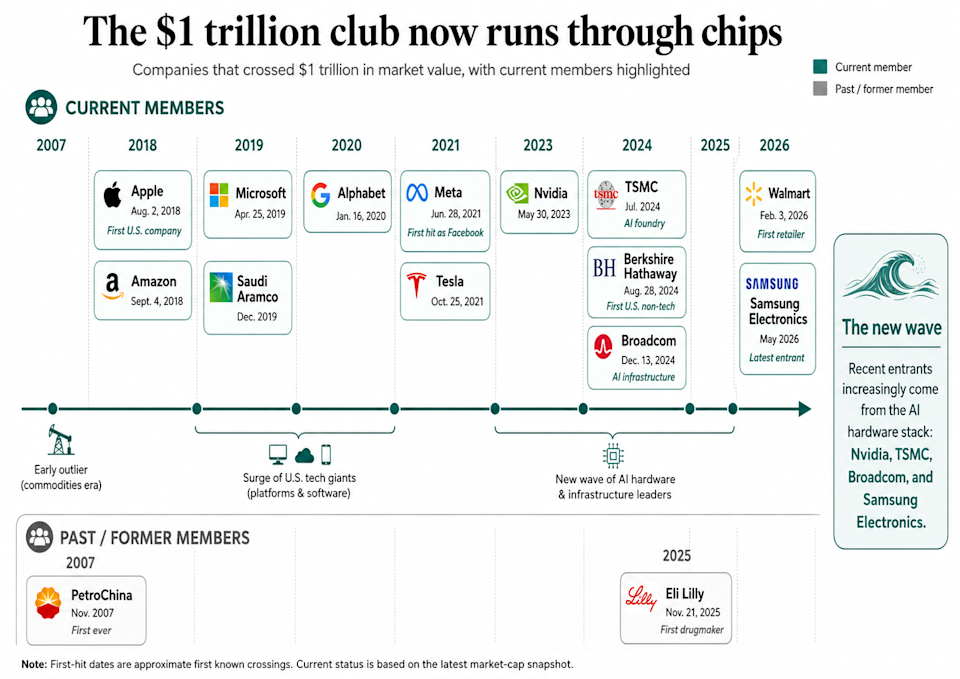
The global stock market is undergoing a major structural transformation as artificial intelligence reshapes which companies dominate global valuations. The exclusive “$1 trillion club,” once dominated primarily by consumer internet platforms and software giants, is now increasingly defined by semiconductor manufacturers, infrastructure providers, and hardware suppliers powering the AI revolution.
Samsung Electronics has recently joined this elite group, marking a significant milestone in the evolution of global technology leadership. The company now stands alongside other AI-driven market giants such as Nvidia, TSMC, and Broadcom—firms that collectively form the backbone of modern artificial intelligence systems.
This shift highlights a broader change in investor priorities. Instead of focusing solely on consumer-facing platforms, markets are now rewarding companies that supply the critical computing infrastructure enabling AI development at scale.
From Digital Platforms to Physical AI Infrastructure
The original wave of trillion-dollar companies was built on digital ecosystems. Firms like Apple, Amazon, Microsoft, Alphabet, Meta, and Tesla achieved massive valuations through dominance in areas such as smartphones, cloud computing, online advertising, social media, e-commerce, and electric vehicles.
These companies represented a software- and platform-driven era of growth, where value creation was largely tied to user engagement, digital services, and network effects.
However, the current wave of trillion-dollar companies is fundamentally different. It is centered on physical infrastructure—specifically semiconductors, memory chips, advanced manufacturing, and high-performance computing systems.
This new phase of market leadership is driven by the rapid expansion of artificial intelligence workloads, which require enormous amounts of computing power, specialized hardware, and high-speed memory systems.
As a result, companies that previously operated in the background of the technology ecosystem are now becoming some of the most valuable businesses in the world.
Nvidia Leads the AI Revolution in Market Valuation
Nvidia’s rise above the $1 trillion valuation threshold marked one of the most significant turning points in modern financial markets.
The company’s graphics processing units (GPUs) have become essential infrastructure for training and deploying artificial intelligence models. As demand for AI computing exploded, Nvidia’s hardware became one of the most critical bottlenecks in the global technology supply chain.
Unlike traditional semiconductor cycles, the AI boom has created sustained demand for high-performance computing systems rather than short-term cyclical spikes. This structural demand shift has allowed Nvidia to maintain strong pricing power and exceptional revenue growth.
Nvidia’s position in the AI ecosystem is not limited to hardware. Its software platforms, developer tools, and ecosystem integration have also helped lock in long-term customer dependency across cloud providers, startups, and enterprise AI developers.
TSMC and Broadcom Strengthen the AI Supply Chain
Taiwan Semiconductor Manufacturing Company (TSMC) plays a crucial role in the AI industry as the world’s leading advanced chip manufacturer. It produces cutting-edge semiconductors for companies such as Nvidia, Apple, and other major technology firms.
As AI demand grows, TSMC has become one of the most important bottlenecks in global computing capacity. Advanced chip fabrication requires highly specialized manufacturing processes, and only a small number of companies globally can produce chips at the most advanced nodes.
Broadcom, meanwhile, has benefited from rising demand for custom AI chips and networking infrastructure. As AI workloads expand across data centers, the need for high-speed data transfer, interconnect systems, and specialized silicon solutions has increased significantly.
Together, Nvidia, TSMC, and Broadcom represent different layers of the AI infrastructure stack—from chip design to manufacturing to system-level connectivity.
Samsung’s Entry Signals the Rise of Memory as a Strategic Asset
Samsung Electronics joining the $1 trillion market capitalization club reflects the growing importance of memory chips in the AI ecosystem.
While GPUs and processors often receive the most attention, memory—particularly high-bandwidth memory (HBM)—is essential for handling the massive data requirements of AI models.
AI systems require extremely fast data access to process large datasets, train models, and run inference at scale. This has made advanced memory technology a critical component of modern AI infrastructure.
Samsung’s inclusion in the trillion-dollar club underscores how investors are now valuing companies that provide foundational components rather than just consumer-facing technologies.
Memory chips, once considered a cyclical and commodity-driven segment, are now seen as strategic assets due to persistent AI-driven demand.
The AI Economy Is Built on Bottlenecks
A defining feature of the current AI boom is that value is increasingly concentrated in supply chain bottlenecks.
Unlike previous technology cycles, where software platforms captured the majority of value, the AI era rewards companies that control scarce physical resources such as:
- Advanced semiconductor fabrication capacity
- High-performance GPU production
- High-bandwidth memory supply
- Data center infrastructure
- Networking hardware for AI clusters
This shift explains why companies that enable AI computation—not just those that develop AI applications—are rapidly entering the $1 trillion valuation tier.
The scarcity of critical components has created pricing power and sustained demand, allowing infrastructure providers to grow at extraordinary rates.
Beyond Technology: Other Trillion-Dollar Companies Still Exist
While AI-related firms dominate the latest wave of trillion-dollar companies, the club is not exclusively technological.
Berkshire Hathaway became the first major non-tech company to reach the milestone, reflecting the strength of its diversified investment portfolio and insurance operations.
Walmart’s inclusion highlights the enduring scale of global retail infrastructure, while companies like Saudi Aramco and PetroChina demonstrate the continued importance of global energy markets.
Eli Lilly’s brief entry into the trillion-dollar category further shows how pharmaceutical innovation—particularly in high-demand therapeutic markets—can also drive extraordinary valuations.
However, despite these exceptions, the most consistent trend in recent years has been the dominance of AI-related infrastructure companies.
Why AI Is Reshaping Market Leadership
The expansion of the $1 trillion club is not just a financial milestone—it reflects a deeper transformation in the global economy.
Artificial intelligence requires unprecedented computing power, and this demand is reshaping capital allocation across industries. Investors are increasingly rewarding companies that sit at the foundation of AI development rather than those that merely consume or deploy AI applications.
This has created a new hierarchy in global markets:
- Chip designers (Nvidia)
- Semiconductor manufacturers (TSMC, Samsung)
- Infrastructure providers (Broadcom)
- Cloud computing platforms (Microsoft, Amazon, Google)
At the top of this structure are companies that control physical production constraints, rather than purely digital services.
Conclusion: The $1 Trillion Club Now Reflects the AI Supply Chain
The evolution of the $1 trillion market capitalization club highlights how deeply artificial intelligence is reshaping global financial markets.
What was once a group dominated by consumer internet giants has now expanded into a more complex ecosystem built around semiconductors, memory chips, manufacturing capacity, and AI infrastructure.
Companies like Nvidia, TSMC, Broadcom, and Samsung are no longer just suppliers—they are central pillars of the global AI economy.
As artificial intelligence continues to scale, the companies that control the physical bottlenecks of computing power are likely to remain at the center of market growth and investor attention for years to come.
About The Author