In economics, price scissors refers to a situation in which prices of certain goods, particularly agricultural and industrial products, diverge sharply over time. This divergence can have significant consequences for an economy, affecting producer incomes, consumer prices, and trade balances.
The term was famously used by Leon Trotsky to describe the economic crisis in the Soviet Union during the early 1920s, when industrial and agricultural prices moved in opposite directions. Understanding price scissors provides insight into how price imbalances arise, the risks they pose to both producers and consumers, and the policies that can mitigate their effects.
This article explores the dynamics of price scissors, examines its historical examples, and analyzes its impact on modern economies.
What Are Price Scissors?
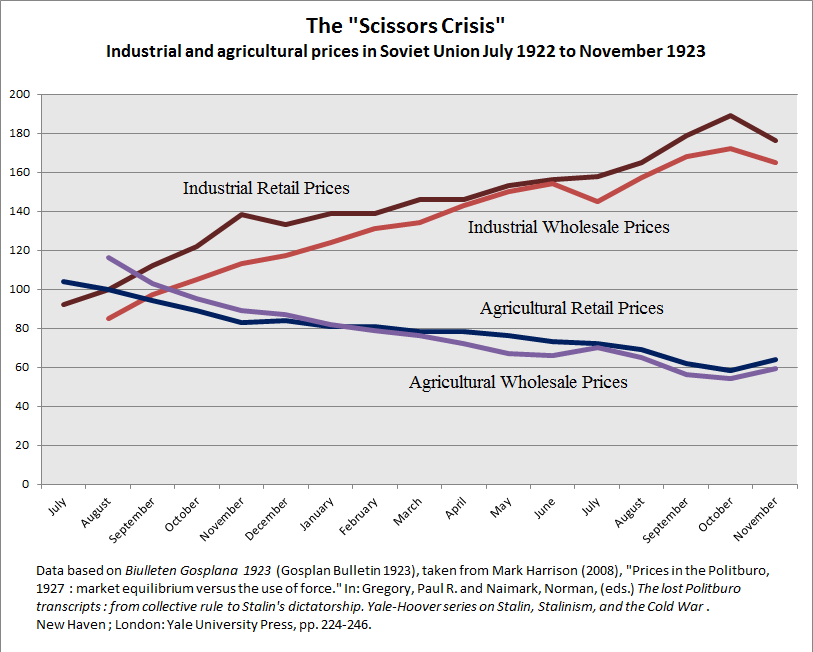
Price scissors occur when there is a sustained divergence in the prices of different goods, particularly between agricultural and industrial products. Graphically, this divergence resembles the opening blades of a pair of scissors, where one price index rises while the other falls.
Historically, the phenomenon was first observed during the Soviet Scissors Crisis of 1922–1923. Trotsky used the term to highlight the widening gap between industrial and agricultural prices during the New Economic Policy (NEP) era.
Today, price scissors can emerge in any economy where global demand fluctuations, trade imbalances, or policy distortions cause significant disparities between export prices and import costs. For instance, countries that rely heavily on agricultural exports but import industrial goods may experience declining farmer incomes if commodity prices fall while industrial product costs rise.
How Price Scissors Work: Economic Mechanics
The name “price scissors” comes from its visual representation on a price chart. Time is plotted on the horizontal axis, and price levels on the vertical axis. Industrial prices trend upward, while agricultural prices trend downward, creating a V-shaped divergence resembling an open pair of scissors.
The economic consequences of price scissors are particularly severe when a country is:
- A net exporter of agricultural goods
- A net importer of industrial goods
For example, suppose a country exports dairy products and imports textiles. If the global price of milk falls while textile prices rise sharply, domestic farmers earn less from their produce. Meanwhile, consumers face higher costs for industrial goods. The net effect is a decline in farm incomes and a rise in living costs, squeezing both producers and households.
Price scissors can therefore destabilize domestic economies, create social unrest, and reduce overall economic efficiency.
Historical Example: The Soviet Scissors Crisis (1922–1923)
The Scissors Crisis in the Soviet Union remains the most notable historical example of price scissors. Following the 1921–1922 famine and the devastation of the Russian Civil War, the Soviet economy struggled to stabilize.
During this period:
- Agricultural prices fell 10% below their levels a decade earlier
- Industrial prices rose 250% higher than pre-war levels
The resulting divergence caused peasant farmers’ incomes to drop sharply, making it increasingly difficult to purchase manufactured goods. Many farmers retreated to subsistence farming, worsening food shortages and sparking fears of famine.
Causes of the Crisis
Several factors contributed to the Soviet price scissors:
- Fixed grain prices: To prevent famine, the government artificially set grain prices low, discouraging agricultural sales.
- Industrial production lag: While agriculture rebounded quickly after the war, industrial output remained constrained due to destroyed infrastructure and machinery.
- Economic mismanagement: Poor policy coordination under the NEP allowed the imbalance to persist, aggravating the divergence between sectors.
Resolution
The crisis eased when the Soviet government:
- Cut industrial production costs through rationalization, layoffs, and wage adjustments
- Promoted consumer cooperatives, improving access to goods and reducing industrial prices
These measures narrowed the gap between industrial and agricultural prices, stabilizing the economy and mitigating social unrest.
Modern Implications of Price Scissors
While price scissors is often discussed in historical contexts, similar dynamics can appear in today’s global economy:
- Commodity-exporting countries may face declining farm incomes if global crop prices fall while importing machinery or electronics becomes more expensive.
- Industrializing nations may experience inflation in manufactured goods alongside stagnant agricultural prices, creating regional economic inequalities.
- Policy missteps, such as price controls or subsidies, can amplify the effects of price divergence.
Understanding price scissors is therefore essential for governments, policymakers, and investors seeking to balance sectoral growth, stabilize incomes, and prevent social unrest.
Key Takeaways
- Price scissors describe a divergence in prices between agricultural and industrial goods, which can harm farm incomes and raise living costs.
- The term originates from the 1922–1923 Soviet Scissors Crisis, where industrial prices rose sharply while agricultural prices fell.
- Causes include fixed prices, industrial production constraints, and policy mismanagement.
- Modern economies can experience similar imbalances due to global trade fluctuations, commodity price volatility, or economic mismanagement.
- Policies such as cost reductions, cooperatives, and careful price adjustments can help mitigate the effects of price scissors.
The Bottom Line
Price scissors illustrate how price imbalances between different sectors can strain economies, reduce producer incomes, and increase consumer costs. The Soviet Scissors Crisis remains a historic example of the consequences of misaligned prices and ineffective economic management.
By studying price scissors, policymakers and economists can better understand the interaction between agricultural and industrial sectors, design effective interventions, and prevent similar imbalances in modern economies.
About The Author