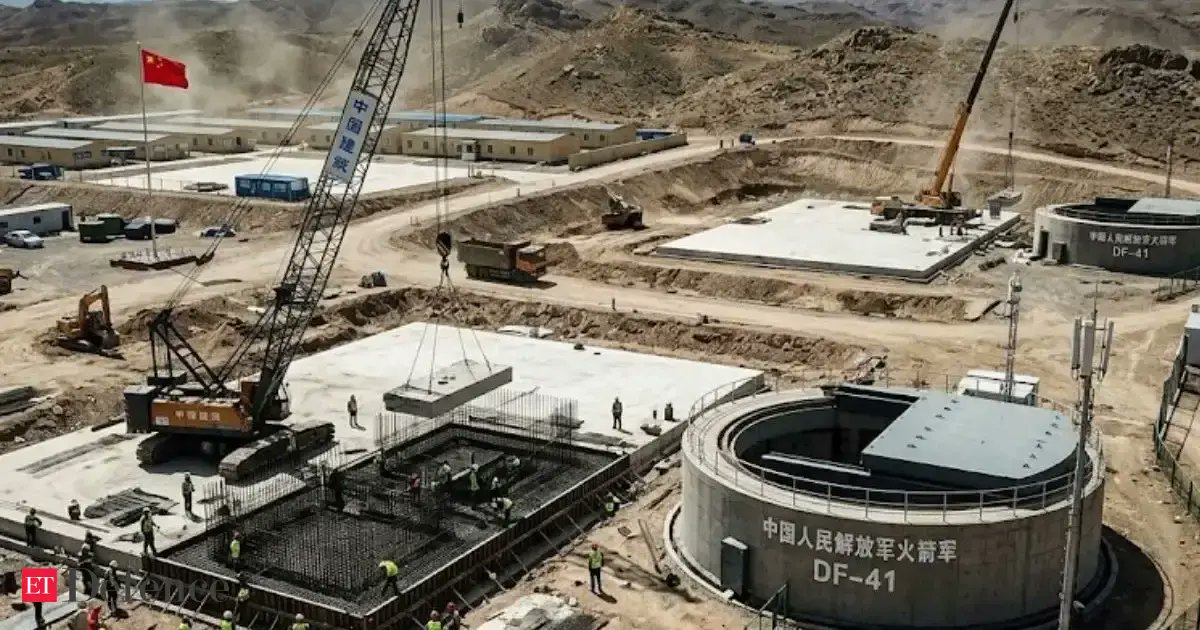
China Accelerates Construction of Strategic Nuclear Infrastructure
China is dramatically expanding its military infrastructure in the remote deserts of northwestern China, signaling a major transformation in the country’s nuclear defense strategy. Recent satellite imagery has revealed the construction of dozens of launch pads, fortified military complexes, underground communication systems, and defensive installations near China’s intercontinental ballistic missile (ICBM) silo fields.
Security analysts believe the growing network is designed to ensure that China can maintain a reliable nuclear retaliation capability even if its missile silos come under attack. The development represents one of the largest military infrastructure projects undertaken by Beijing in recent years and highlights the intensifying strategic rivalry between China and the United States.
The newly identified military sites are located primarily near the Hami nuclear silo field in the Xinjiang region, an isolated desert area already known for housing long-range Chinese missile systems. According to defense experts, the enormous scale of construction suggests China is investing heavily in protecting and modernizing its land-based nuclear forces.
Massive Launch Pad Network Discovered Near Hami Silo Field
Satellite imagery reviewed by military researchers has identified more than 80 concrete launch pads scattered across the desert landscape near the Hami missile fields. Analysts believe these sites could support mobile missile launchers, air-defense systems, electronic warfare equipment, or command-and-control operations.
The launch pads are spread over thousands of square kilometers and connected by a network of roads, conduits, and support facilities. Their strategic placement among rocky terrain and dry creekbeds could provide natural concealment and improve survivability during a military conflict.
Defense specialists say some of the larger pads may accommodate truck-mounted intercontinental ballistic missiles capable of carrying nuclear warheads. China already possesses missiles that can strike targets across the continental United States, but the new infrastructure appears focused on ensuring these weapons remain operational during a potential first strike by an adversary.
Military analysts describe the construction effort as unprecedented in both size and complexity. The hardened infrastructure could significantly strengthen China’s nuclear deterrence posture and increase the flexibility of its missile forces.
Octagon-Shaped Military Complexes Raise Questions
At the center of the expanding defense network are two unusual octagon-shaped military installations constructed in eastern Xinjiang over the last several years. These facilities are positioned southwest of the Hami silo fields and are connected to nearby military infrastructure through roads, rail systems, and communication lines.
Satellite photographs show that each octagonal complex contains multiple rings of buildings and heavily fortified structures. Analysts believe the central buildings may function as command centers, while surrounding rings appear to house military personnel, vehicle storage facilities, and operational support units.
The outer sections of the complexes include armored bunkers, reinforced storage areas, and temporary military structures. Satellite images captured during recent months also revealed increased activity around the northern octagon, including vehicle movements, camouflaged military equipment, and temporary encampments.
Several experts suggest the octagons could serve as command, control, and communications hubs for China’s nuclear operations. The presence of satellite dishes, towers, and underground conduits has fueled speculation that the facilities may be linked to advanced military communication systems or electronic warfare capabilities.
The military exercises observed near the sites indicate that China may already be testing operational procedures for mobile missile deployment and defensive coordination in the area.
China Focuses on Strengthening Second-Strike Capability
One of the primary goals of China’s nuclear modernization appears to be improving its second-strike capability. In nuclear strategy, second-strike capability refers to a nation’s ability to launch a retaliatory nuclear attack even after suffering an enemy first strike.
China has long maintained a “no first use” nuclear policy, officially stating that it would never initiate a nuclear conflict. However, Beijing still considers it essential to maintain a credible deterrent capable of surviving any surprise attack.
The desert silo fields in Xinjiang and neighboring Gansu province form the backbone of China’s land-based nuclear arsenal. While China also operates submarine-launched and air-delivered nuclear weapons, the missile silos remain central to the country’s strategic defense planning.
By building extensive launch networks, hardened shelters, and communication infrastructure, China may be attempting to reduce the vulnerability of its nuclear forces. Mobile launchers, in particular, are more difficult to detect and destroy compared to fixed missile silos.
Analysts believe the infrastructure expansion demonstrates China’s growing concern over potential military confrontation with the United States, especially as tensions continue over Taiwan and regional security issues in the Indo-Pacific.
Growing Nuclear Competition Between China and the United States
China’s rapid military modernization has become one of the most closely monitored security developments in the world. American officials and arms-control researchers have repeatedly warned that Beijing is expanding its nuclear arsenal faster than any other major power.
Recent Pentagon assessments estimate that China could possess around 1,000 nuclear warheads by 2030. The reports also indicate that the country has likely deployed roughly 100 intercontinental ballistic missiles across its three primary silo fields.
At the same time, China has reportedly improved its missile early-warning systems through advanced satellite technology. According to U.S. defense assessments, China’s space-based warning network can detect incoming ballistic missile launches within minutes, providing enough time for a retaliatory response.
The combination of silo construction, mobile missile launch capability, and enhanced early-warning systems could dramatically improve China’s nuclear survivability.
Security experts say the expanding infrastructure differs from the traditional nuclear strategies used by the United States and Russia. While those countries rely heavily on large numbers of hardened silos and submarine-based deterrence, China appears to be integrating mobility, concealment, and layered defense into its strategic planning.
Military Experts Call Construction Effort Extraordinary
The scale of China’s desert military expansion has surprised even experienced nuclear analysts. Experts who reviewed the satellite imagery described the project as one of the most ambitious nuclear defense infrastructure developments seen in recent decades.
Researchers point out that constructing such a massive military network in a harsh desert environment requires enormous financial resources, engineering capabilities, and logistical coordination. Roads, rail terminals, airfields, fuel storage sites, and underground communication systems are all being integrated into the expanding defense network.
Some analysts believe the infrastructure may serve multiple military purposes beyond nuclear deterrence, including missile defense, electronic warfare operations, and strategic logistics support.
A third octagon-shaped site located farther south near the Lop Nur nuclear test region appears to function as a military target range. Satellite images show damaged structures, cratered terrain, and mock aircraft designed to simulate foreign military equipment.
The continuing expansion of these facilities suggests that China is preparing for a future in which nuclear deterrence and strategic competition will play an increasingly central role in global security.
Rising Tensions Could Reshape Global Nuclear Balance
China’s growing nuclear infrastructure comes at a time of rising geopolitical tension between Beijing and Washington. Disputes over Taiwan, military activity in the South China Sea, technology restrictions, and regional alliances have all contributed to a deteriorating relationship between the world’s two largest powers.
Military analysts warn that the rapid modernization of nuclear forces on all sides could increase the risks of miscalculation and escalation during future crises. As China strengthens its strategic deterrent, the United States and its allies may respond with additional military investments and expanded regional defense cooperation.
The newly discovered launch networks and military complexes in China’s western deserts illustrate how the global nuclear landscape is evolving. While Beijing insists its military expansion is defensive in nature, the scale and sophistication of the infrastructure underscore China’s determination to secure a stronger position in the modern balance of power.
As satellite imagery continues to reveal new construction and military activity, international attention will remain focused on how China’s expanding nuclear capabilities may reshape global security in the years ahead.
About The Author