What Happens to Stocks When Oil Prices Double? History Offers a Surprising Pattern
A sharp surge in oil prices often triggers fears of economic slowdown and stock market losses. But historical data suggests the relationship between energy shocks and equity markets may be more complex than many investors assume.
According to research from JPMorgan Chase, stock markets have frequently recovered and even posted gains after major oil price spikes, despite the immediate turbulence they create.
The current geopolitical tensions involving Iran have pushed oil markets into extreme volatility, raising questions about how global equities might respond if prices continue climbing.
What History Shows About Oil Price Surges
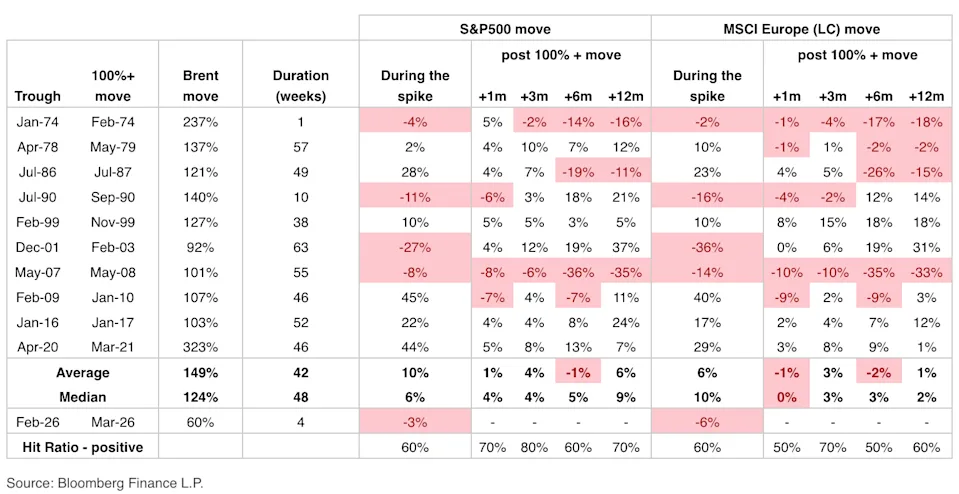
Looking at market data going back to 1974, analysts found that periods when oil prices surged more than 100% were often followed by positive returns in the stock market.
Specifically, the benchmark S&P 500 showed median gains across multiple time horizons after major oil shocks:
- 1 month after spike: Positive median performance
- 3 months: Continued gains
- 6 months: Market recovery typically underway
- 1 year: Historically higher levels than during the spike
During the period when oil prices were surging, the index recorded a median gain of around 6%.
This pattern suggests that markets often adjust to higher energy prices after an initial period of volatility.
Why Oil Shocks Hurt the Economy First
Despite the longer-term resilience of stock markets, economists warn that higher oil prices can cause immediate economic pain.
Energy costs affect nearly every sector of the economy. When crude oil becomes more expensive, the impact spreads quickly through supply chains and consumer spending.
Oil prices influence:
- Gasoline prices for drivers
- Diesel costs for trucking and logistics
- Airline fuel expenses
- Manufacturing and shipping costs
- Food prices through transportation
As a result, sudden increases in oil prices can reduce consumer spending power and slow economic growth.
War Premium Driving Oil Prices Higher
Since the launch of Operation Epic Fury on February 28, energy markets have rapidly priced in geopolitical risks.
Before the conflict escalated, crude oil traded around $72 per barrel. Within weeks, prices surged dramatically.
The benchmark Brent crude briefly climbed to $119 per barrel in early March. Prices have since stabilized somewhat but remain highly volatile.
Currently, oil is trading around $113 per barrel, representing nearly a 60% increase in less than a month.
A key factor behind the spike is the potential disruption of shipping through the Strait of Hormuz, a narrow waterway through which roughly 20% of the world’s oil supply passes.
Any prolonged disruption there could push oil prices even higher.
Stock Markets Already Feeling the Pressure
Rising energy costs have already begun to weigh on equities.
The S&P 500 recently experienced its most significant technical breakdown in more than a year.
After reaching an all-time high of 6,797 in January, the index has posted four consecutive weeks of losses. It has also fallen below its important 200-day moving average, a widely watched indicator of long-term market trends.
The index is now trading near 6,506, roughly 6% below its peak.
Some of the biggest declines have occurred in high-growth technology companies often referred to as the “Magnificent Seven.” Shares of major AI chipmaker Nvidia, for example, recently dropped below its own 200-day moving average.
Why Investors Should Be Cautious
While history shows markets often recover after oil shocks, strategists caution that further price spikes could trigger deeper market corrections.
If crude oil climbs toward $120 to $130 per barrel or higher, analysts say stock markets may need to reprice downward to reflect the risk of slower economic growth.
Higher energy costs also increase inflation pressure, which can lead central banks to maintain higher interest rates for longer periods.
This combination—rising inflation and higher borrowing costs—can create a difficult environment for stocks.
The Direct Impact on Consumers
Beyond financial markets, rising oil prices quickly affect everyday spending.
Higher fuel costs reduce household disposable income almost immediately. Drivers feel the impact every time they fill their gas tanks.
Gasoline prices in the United States are already approaching $4 per gallon, while diesel prices—critical for freight transportation—have surged even more sharply.
According to former Trump Administration economic advisor Gary Cohn, the effect on consumer behavior can be immediate.
When families suddenly spend more on fuel, they often cut discretionary spending elsewhere, such as dining out, travel, or entertainment.
That reduction in consumer spending can ripple through the broader economy.
The Key Variable: Oil Prices
For investors and economists alike, the trajectory of oil prices remains the most important factor in determining what happens next.
If geopolitical tensions ease and oil prices stabilize, stock markets may eventually rebound—following the pattern seen in past oil shocks.
But if supply disruptions worsen and crude prices continue climbing, the economic and financial consequences could become more severe.
For now, markets remain on edge as energy prices, geopolitics, and global growth prospects collide in one of the most volatile periods for oil in years.
About The Author