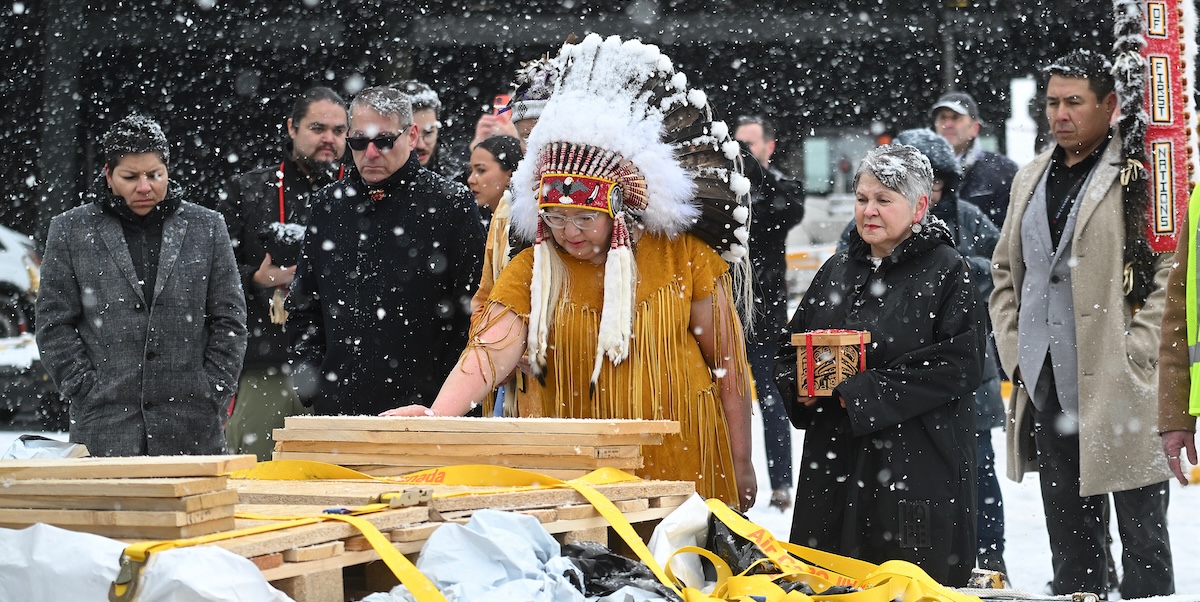
Assembly of First Nations National Chief Cindy Woodhouse Nepinak places her hand on indigenous and cultural artifacts at Trudeau Airport in Montreal, Saturday, Dec. 6, 2025, after they were returned by the Vatican. (Graham Hughes /The Canadian Press via AP)
As part of a reconciliation process addressing past abuses, the Vatican has returned dozens of artifacts to Indigenous communities in Canada.
Between 1923 and 1925, Pope Pius XI instructed missionaries to collect thousands of cultural items from around the world for a major exhibition in Rome. Many of these artifacts came from Canada, handed over to Catholic missionaries by local Indigenous peoples.
For nearly a century, these objects remained in the Vatican Museums, despite repeated requests for their return from Indigenous representatives. The Vatican had long resisted, arguing the items had been donated to the Church and therefore legally belonged to it. On Saturday, December 6, however, a small batch of 62 artifacts was finally returned to Canada, arriving at Montreal’s Trudeau Airport.
The Artifacts
The returned objects include items of craftsmanship and cultural significance. Among them is a rare Inuvialuit kayak, used historically for hunting beluga whales—a vessel no longer in possession of the Inuvialuit today. Fourteen artifacts are confirmed as Inuvialuit, one belongs to the Métis people, and the rest are from various First Nations communities.
The artifacts are now being temporarily housed at the Canadian Museum of History in Ottawa, where they will be cataloged and examined before being returned to their original communities.
For Indigenous peoples, these items carry immense historical, cultural, and spiritual value. Katisha Paul, representing the Tsartlip and Lil’wat nations, emphasized that the artifacts are not merely historical objects but “our ancestors, markers of the vitality of our nations’ history.”
The Path to Repatriation
Negotiations for the return were long and complex. Indigenous representatives and historians argued that even if the artifacts were technically “donated,” the power imbalance between the Church and Indigenous communities in the early 20th century meant such donations could not be considered truly voluntary.
The historical context includes widespread abuses by the Catholic Church, especially during the era of Residential Schools, where Indigenous children were forcibly assimilated, often suffering physical and psychological abuse and, in many cases, death.
Public debates about the Residential Schools in Canada led Indigenous communities to demand both an official apology and the return of cultural artifacts. In 2022, Pope Francis issued an apology on behalf of the Church. The repatriation of these artifacts marks a significant step in the ongoing process of reconciliation with Canada’s Indigenous peoples.
About The Author