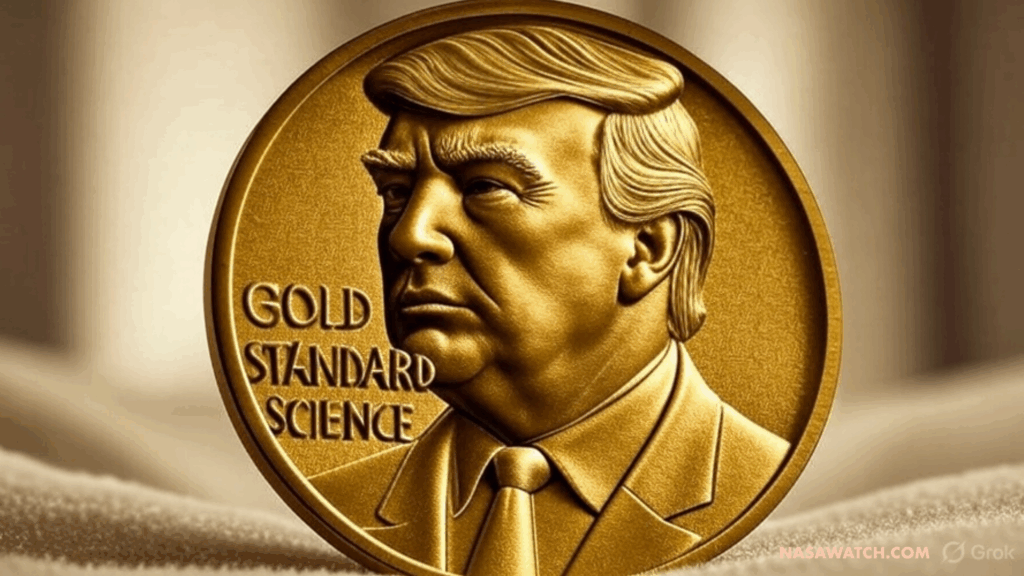
The U.S. government is launching a major initiative to rebuild public trust in scientific research after several years of declining confidence and controversy. A new executive order, titled “Restoring Gold Standard Science,” outlines sweeping reforms designed to improve scientific integrity, transparency, and the reliability of federally supported research.
Why the Order Was Issued
Over the past five years, public confidence in science has dropped sharply, while many researchers themselves warn of a growing reproducibility crisis. Several high-profile retractions tied to falsified data have further damaged trust—especially when the studies involved federal funding.
The order points to several incidents where agencies misused or misrepresented scientific information:
- COVID-19 school guidance under the previous administration included edits from the American Federation of Teachers and was interpreted as discouraging in-person learning, despite evidence that children rarely experienced severe illness and that schools could open safely with reasonable precautions.
- The National Marine Fisheries Service relied on a projected “worst-case scenario” for the North Atlantic right whale population—an assumption later deemed unrealistic and struck down by a federal court.
- Agencies often used climate model scenario RCP 8.5, a worst-case projection based on highly unlikely assumptions about coal use, despite warnings from researchers that it should not be treated as a probable outcome.
- The prior administration also pushed agencies to embed diversity, equity, and inclusion objectives into scientific operations, a move the current administration describes as politicizing scientific processes.
According to the new order, restoring trust requires a return to rigorous, transparent, and unbiased scientific practices.
Establishing “Gold Standard Science”
The executive order directs the Office of Science and Technology Policy (OSTP) to issue government-wide guidance defining Gold Standard Science—research that is:
- reproducible
- transparent about methods and data
- open about error and uncertainty
- interdisciplinary
- skeptical of assumptions
- structured for falsification
- peer-reviewed without bias
- accepting of negative results
- free of conflicts of interest
Once OSTP releases the guidance, all federal agencies must revise their scientific integrity policies to align with these principles and apply them to research, analysis, communication, and decision-making.
New Rules for Using and Communicating Scientific Data
Within 30 days, agencies and their employees must follow stricter standards for how scientific data is used and shared. Key requirements include:
- No scientific misconduct, including fabrication, falsification, or plagiarism.
- Public access to influential scientific information—data, analysis, models, and in some cases source code—unless limited by law, national security, or confidentiality requirements.
- Clear communication of uncertainties, including how uncertainty affects model outputs.
- Transparency around the likelihood of assumptions and scenarios, discouraging reliance on unrealistic worst-case projections unless required by law.
- Use of a “weight of scientific evidence” approach that evaluates and integrates all relevant information objectively.
- Communications must accurately represent results, including uncertainties and key assumptions.
Interim Rules and Policy Revisions
Until agencies complete new integrity policies, they must operate under scientific integrity policies that existed as of January 19, 2021—unless those policies conflict with this new order.
Agencies must also:
- Review and potentially revise scientific actions, rules, and policies issued between January 20, 2021, and January 20, 2025.
- Restore organizational structures altered under the revoked 2021 memorandum on “Restoring Trust in Government Through Scientific Integrity.”
- Encourage open scientific debate and protect researchers who hold dissenting views.
Enforcement and Accountability
Each agency must establish a process—led by a designated senior appointee—to investigate alleged scientific integrity violations. These processes will be the exclusive mechanism for evaluating and addressing scientific misconduct related to agency work.
Violations can result in correction of scientific information and may be referred for disciplinary action when appropriate.
Waivers and National Security Exceptions
Agency heads may request waivers from certain requirements if they demonstrate “good cause.”
Additionally, the order applies to foreign affairs, military activities, and national security operations only when the agency head determines it is appropriate.
A Push to Rebuild Trust in Government Science
In announcing this initiative, the administration emphasized the need to re-establish rigorous, unbiased scientific practices that strengthen public trust. By prioritizing transparency, reliability, and open inquiry, the new Gold Standard Science framework aims to ensure that federal research better serves both policymakers and the American public.
About The Author