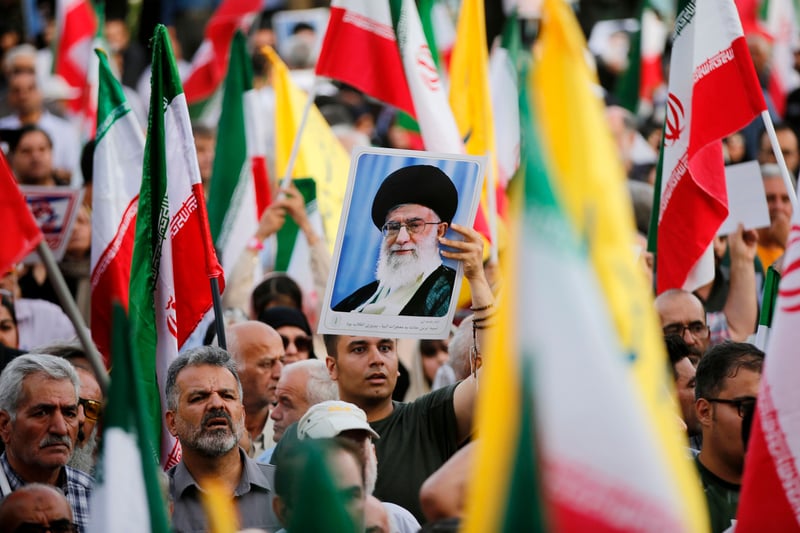
(250625) -- TEHRAN, June 25, 2025 (Xinhua) -- People celebrate the ceasefire between Iran and Israeal at Enghelab Square in Tehran, Iran, on June 24, 2025. The ceasefire was declared on Tuesday. (Xinhua) Xinhua News Agency / eyevine
Iran’s Leadership Transition Amid War: Mojtaba Khamenei Emerges as Potential Supreme Leader
Iran may soon witness one of the most significant political transitions in its modern history. A senior Iranian cleric has suggested that Mojtaba Khamenei, the son of the late Supreme Leader Ayatollah Ali Khamenei, is poised to become the next Supreme Leader of the Islamic Republic. This development comes at a moment of intense military conflict in the region, as Iran confronts attacks from Israel and escalating geopolitical pressure from the United States.
The possibility of Mojtaba Khamenei inheriting the country’s highest position has sparked debate both within Iran and internationally. The Supreme Leader holds ultimate authority in Iran’s political system, controlling key decisions on national security, foreign policy, and the military. Therefore, selecting a successor during an ongoing war could shape the future of the Middle East for years to come.
At the same time, violence across the region has intensified, with missile strikes, drone attacks, and cross-border military operations affecting several countries in the Gulf. As tensions escalate, the leadership transition inside Iran has become even more consequential.
The Search for Iran’s Next Supreme Leader
Following the death of Ayatollah Ali Khamenei during the early phase of military strikes against Iran, the country’s powerful Assembly of Experts began the process of choosing a new Supreme Leader. This influential body of 88 clerics is constitutionally responsible for appointing the individual who will hold the most powerful position in the Islamic Republic.
According to remarks made by senior cleric Ayatollah Hosseinali Eshkevari, the vote to select the next leader has already taken place. While the official announcement has not yet been released, Eshkevari indicated that the Khamenei name would remain at the helm of Iran’s leadership.
Many analysts believe Mojtaba Khamenei is the most likely successor. Known for his conservative ideology and close ties to Iran’s security institutions, he has spent years cultivating influence within political, military, and religious circles. His potential appointment would signal continuity in Iran’s ideological direction and reinforce the dominance of hardline factions within the government.
However, making the decision public may be complicated by the current security situation. With ongoing Israeli military operations targeting Iranian officials and strategic infrastructure, authorities may delay a formal declaration to reduce risks.
Rising Tensions Between Iran, Israel, and the United States
The leadership transition is unfolding amid a rapidly escalating conflict involving Iran, Israel, and the United States. Israel has significantly expanded its military campaign against Iranian targets, striking strategic infrastructure including fuel storage facilities near Tehran.
Large plumes of smoke were reportedly visible across the Iranian capital after the attacks ignited massive fires in oil storage depots. Iranian officials have condemned the strikes, arguing that targeting fuel infrastructure releases toxic substances into the atmosphere and threatens civilian populations.
Iran’s Foreign Ministry has labeled the attacks a serious escalation and accused Israel of committing war crimes by targeting facilities that could produce widespread environmental damage.
Israeli officials, however, defend the operations as legitimate military actions. According to Israeli military representatives, the fuel depots were linked to Iran’s missile production and logistical support for its military operations. Israeli leaders have vowed to continue targeting key assets that support Iran’s military capabilities.
The conflict has also drawn strong statements from Washington. U.S. President Donald Trump has demanded what he described as an “unconditional surrender” from Iran, while also insisting that the United States should have influence over the selection of Iran’s next Supreme Leader — a proposal that Iranian officials have firmly rejected.
Expanding Conflict Across the Gulf Region
The war is no longer limited to Iran and Israel. The conflict has begun to spread across the broader Gulf region, with several countries reporting drone and missile attacks attributed to Iranian forces.
Saudi Arabia, Kuwait, Bahrain, and the United Arab Emirates have all reported incidents involving Iranian drones or ballistic missiles. Some of these attacks have resulted in casualties and damage to infrastructure.
In Kuwait, a major fire broke out in a government office building following a drone strike, killing two police officers. The United Arab Emirates reported that several migrant workers had died as a result of missile and drone attacks during the conflict.
Bahrain also reported an Iranian drone strike on a desalination facility. While the attack caused structural damage, authorities said water supplies were not significantly disrupted. This incident marked the first known attack on a desalination plant during the ongoing war.
Such facilities are critical for Gulf nations that rely heavily on desalinated seawater for drinking water. Targeting them raises concerns about the vulnerability of essential infrastructure in modern conflicts.
Saudi Arabia has also experienced violence linked to the escalating crisis. A projectile strike in a residential neighborhood in the city of Al-Kharj killed two people and injured more than a dozen others.
Officials in Riyadh have reportedly warned Tehran that continued attacks on Saudi territory or energy infrastructure could provoke direct retaliation.
Lebanon and Regional Militias Enter the Conflict
Another dangerous development is the growing involvement of armed groups aligned with Iran across the Middle East. Hezbollah, the powerful militant organization based in Lebanon, has launched rockets and drones toward Israeli territory.
Israel has responded with extensive airstrikes inside Lebanon. Over the past week, hundreds of people have reportedly been killed as Israeli forces target locations believed to house Hezbollah fighters and Iranian commanders.
In one of the most dramatic escalations, Israeli forces struck a hotel in central Beirut, claiming the location was being used by Iranian military officials. The strike killed at least four individuals and marked one of the first attacks on the heart of the Lebanese capital during the current conflict.
Israel has also intensified bombardment in southern Lebanon and other regions believed to host Hezbollah infrastructure.
These developments highlight how the conflict is increasingly turning into a multi-front confrontation involving state and non-state actors across the Middle East.
Strategic Stakes: Nuclear Facilities and Military Operations
The war has raised additional concerns about Iran’s nuclear program. U.S. officials have repeatedly argued that Iran was approaching the capability to produce a nuclear weapon, though detailed evidence has not been publicly presented.
Reports indicate that American and Israeli officials have discussed the possibility of deploying special forces to secure Iran’s stockpile of highly enriched uranium at a later stage of the conflict.
When asked about the possibility of sending ground troops into Iran to secure nuclear sites, President Trump suggested that such a move would only be considered if Iranian forces were severely weakened.
Any attempt to seize nuclear facilities would represent a dramatic escalation with unpredictable consequences.
Human and Economic Consequences of the War
The conflict has already caused substantial casualties on multiple sides. Iranian officials claim that more than 1,300 civilians have been killed in U.S. and Israeli attacks, with thousands more injured.
In Israel, Iranian missile strikes have reportedly killed ten people. Several American service members have also died as a result of attacks on U.S. military facilities in the region.
The war is also disrupting global markets. Energy prices have surged due to fears of supply disruptions in the oil-rich Gulf region. Air travel routes across the Middle East have been affected, forcing airlines to reroute flights and cancel operations.
Businesses across the region are also facing uncertainty as geopolitical tensions threaten trade routes and energy infrastructure.
What Mojtaba Khamenei’s Leadership Could Mean
If Mojtaba Khamenei is officially confirmed as Iran’s next Supreme Leader, it would represent a significant moment in the country’s political evolution. Some observers would interpret the move as a dynastic transition — something critics say contradicts the revolutionary ideals of the Islamic Republic.
Supporters, however, argue that Mojtaba has the experience and connections necessary to lead the country during one of the most dangerous periods in its history.
His leadership could reinforce Iran’s current strategic posture, emphasizing resistance to Western pressure and maintaining strong alliances with regional partners such as Hezbollah.
At the same time, his appointment could deepen tensions with the United States and Israel, both of which view Iran’s leadership and military strategy as a major security threat.
A Defining Moment for Iran and the Middle East
The selection of Iran’s next Supreme Leader is unfolding at a moment when the Middle East stands at the edge of a broader regional war. Military strikes, drone attacks, and geopolitical rivalries are reshaping the strategic landscape.
Whether Mojtaba Khamenei ultimately assumes the role remains to be officially confirmed, but the indications from Iranian clerical leadership suggest that the decision may already be made.
If the Khamenei family retains control of Iran’s highest office, the country’s political direction may remain largely unchanged. However, the surrounding regional conflict ensures that whoever becomes Supreme Leader will face immediate and enormous challenges.
The coming weeks could prove decisive not only for Iran’s leadership but also for the stability of the entire Middle East.
About The Author