Introduction: A Moment That Silenced the Slopes
For 13 brief seconds, Lindsey Vonn’s improbable Olympic comeback was alive. Then, in a flash of speed and violence, one of alpine skiing’s most iconic careers met a moment of raw uncertainty. The American legend’s quest for another Olympic downhill title came to an abrupt and harrowing end after a brutal crash on the fearsome Olimpia delle Tofane course in Cortina d’Ampezzo.
What had been billed as one of the defining storylines of the Milano Cortina Winter Olympics—Vonn racing despite a ruptured anterior cruciate ligament—ended not with triumph, but with stunned silence, gasps from the crowd, and a helicopter lifting the 41-year-old off the mountain.
A Comeback Defined by Risk and Resolve
Vonn’s presence at the start gate alone was extraordinary. At an age when most alpine skiers have long retired, she arrived in Cortina carrying both history and injury. A crash during training in Crans Montana less than two weeks earlier had left her with a serious knee injury, yet she refused to abandon her Olympic dream.
Her determination dominated the opening days of the Games. Fans, analysts, and fellow athletes debated whether the risk was worth the reward. Vonn, as she had done throughout her career, answered with action rather than words.
Wearing bib number 13 and a visible knee brace, she looked composed and focused at the start. A quick tap of the poles, a deep breath, and then she launched herself downhill with the aggressive commitment that had defined her racing style for nearly two decades.
The Crash That Ended It All
The course in Cortina is one Vonn knows better than almost any skier alive. Over the years, she has conquered it repeatedly, collecting 12 World Cup victories there and building a reputation as its undisputed queen. But experience offers no guarantees in downhill skiing, a discipline where margins are razor-thin and speeds exceed 130 kilometers per hour.
Just seconds into her run, disaster struck. Vonn appeared to clip the fourth gate with her shoulder, instantly throwing her off balance. The error was small, but at that velocity, it was catastrophic.
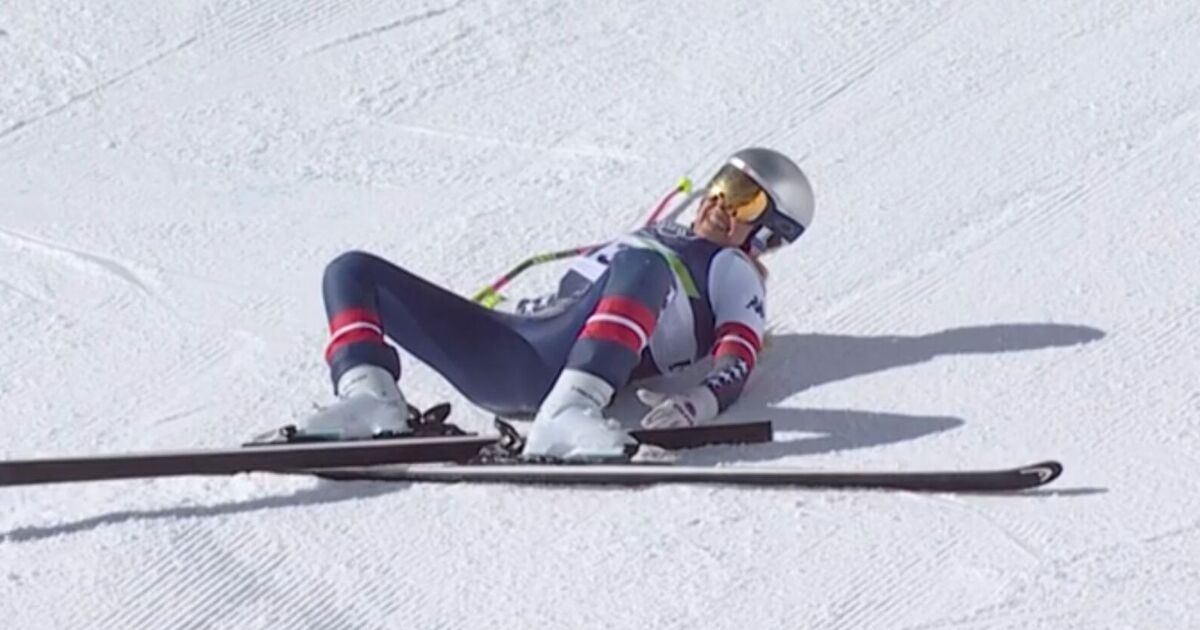
She was launched off the racing line and into open space, tumbling violently before coming to rest in a crumpled heap beside the course. Television microphones picked up her screams as the crowd fell into a shocked hush. What moments earlier had been an atmosphere of anticipation turned into one of dread.
Immediate Medical Response and Evacuation
Race officials and medical personnel rushed to Vonn’s side within seconds. The race was effectively forgotten as attention shifted entirely to the fallen champion. Medics worked quickly, stabilizing her on the snow while teammates and competitors watched in visible distress.
A rescue helicopter soon descended onto the mountain, its arrival underscoring the severity of the incident. Vonn was carefully secured in an orange stretcher and winched aboard, then flown to Codivilla Putti Hospital in Cortina for further evaluation.
As the helicopter passed overhead toward the town, spectators applauded—not in celebration, but in solidarity and respect for a skier who had given everything to the sport.
At the time of evacuation, there was no official update on her condition, adding to the anxiety surrounding the incident.
Shockwaves Through the Olympic Field
Vonn’s crash reverberated through the entire alpine skiing community. As the most recognizable athlete at the Games, her fall cast a shadow over the remainder of the downhill event.
American teammate Breezy Johnson, who had earlier posted the fastest time, struggled to watch the aftermath. Cameras captured her covering her eyes as the helicopter was summoned. Though Johnson would later be crowned Olympic champion, the victory carried a somber tone.
Around the course and across viewing areas in Italy and beyond, skiers and fans reacted with disbelief. In Bormio’s town square, where athletes and spectators watched on a giant screen, fellow American Bryce Bennett stood stunned.
Downhill skiing, he later reflected, can appear deceptively smooth—until it isn’t. In an instant, control gives way to chaos.
A Sport Where Risk Is Inescapable
Downhill skiing has always occupied a unique place in winter sports. It combines precision and fearlessness, rewarding absolute commitment while punishing even the slightest miscalculation. Vonn’s crash was a stark reminder of that reality.
Commentators struggled to maintain composure as replays showed the violence of the fall. Tina Maze, a two-time Olympic gold medallist working as an analyst, suggested that Vonn may have pushed beyond reasonable limits.
Racing while injured is not uncommon in elite sport, but downhill skiing magnifies every weakness. An unstable knee offers no margin for error when navigating jumps, compressions, and high-speed turns.
Yet, as Maze and others acknowledged, Vonn has never raced cautiously. That uncompromising mentality brought her extraordinary success—and ultimately, moments like this.
The Weight of Legacy and Expectation
Vonn entered the Games as the 2010 Olympic downhill champion, already a legend of the sport. She had hoped to make history again by becoming the oldest alpine skiing Olympic medallist, a goal that suddenly seemed within reach after recent World Cup victories earlier in the season.
Those wins reignited belief that her body, battered by years of injuries, could still produce magic on the biggest stage. They also raised expectations—both externally and within herself.
Her decision to race injured was not made lightly. It reflected a career-long willingness to accept danger in pursuit of greatness, a trait that endeared her to fans but often placed her at physical risk.
Reaction From the Sport’s Leadership
International Ski Federation (FIS) president Johan Eliasch addressed the incident with a mixture of realism and reverence. Downhill racing, he noted, carries inherent danger. But he also emphasized Vonn’s immeasurable contribution to alpine skiing.
Her participation, he said, had elevated the profile of the Games and brought unprecedented attention to the sport. While acknowledging the tragedy of the moment, he expressed hope that Vonn would recover swiftly and return to the slopes—if not competitively, then at least in health.
An Uncertain Road Ahead
As Vonn underwent medical assessment, questions loomed. The extent of her injuries remained unclear, as did the future of her career. At 41, with a long history of knee, back, and leg injuries, recovery would be neither simple nor guaranteed.
Yet if her career has proven anything, it is that Lindsey Vonn defies expectations. Time and again, she has returned from injuries that would have ended other careers. Whether this crash marks a final chapter or another painful pause remains to be seen.
Conclusion: Courage, Cost, and the Cruel Edge of Sport
Lindsey Vonn’s Olympic dream ended in just 13 seconds, but the meaning of her effort extends far beyond that brief run. Her crash in Cortina was a brutal reminder of the fine line elite athletes walk between glory and devastation.
In choosing to race, she embodied the essence of downhill skiing—total commitment, unfiltered risk, and unwavering belief. The outcome was heartbreaking, yet it reinforced why Vonn remains one of the most compelling figures in winter sports history.
As the Games continue, her absence will be felt on the mountain and beyond. But her legacy—built on courage, resilience, and an unmatched will to compete—remains firmly intact.
About The Author