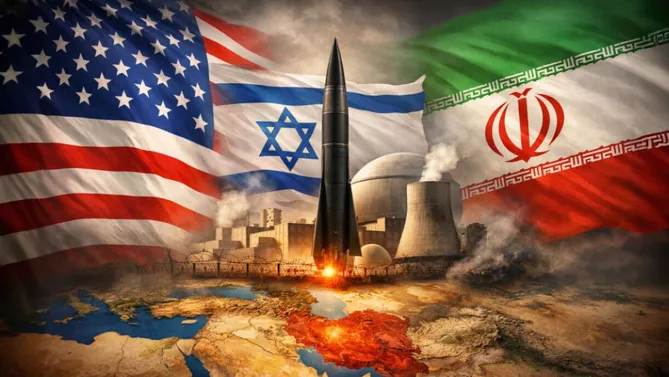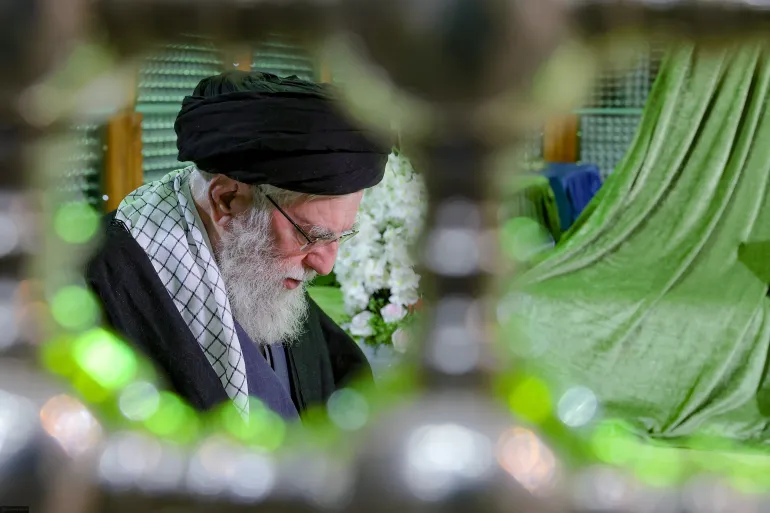
Ayatollah Ali Khamenei, Iran’s Supreme Leader reportedly killed in U.S.-Israeli airstrikes, led the Islamic Republic for 36 years, crushing dissent, confronting the West, and shaping Middle East geopolitics.
The reported death of Ali Khamenei in U.S.–Israeli airstrikes marks a potentially historic turning point for Iran and the broader Middle East. For more than three decades, Khamenei embodied the ideological core of the Islamic Republic—an uncompromising opponent of the United States and Israel, a relentless suppressor of internal dissent, and the ultimate decision-maker in Tehran’s nuclear and regional strategy.
While Iranian authorities have not officially confirmed his death, statements from U.S. President Donald Trump and senior Israeli officials assert that the 86-year-old supreme leader was killed in the strikes. Satellite imagery reportedly shows heavy damage to his Tehran compound, one of the earliest targets in the bombing campaign.
If confirmed, Khamenei’s death would represent the most significant political rupture in Iran since the 1979 Islamic Revolution.
From Revolutionary Cleric to Supreme Authority
Khamenei’s political ascent was not inevitable. Following the 1979 revolution led by Ruhollah Khomeini, Khamenei served in various senior roles, including president. When Khomeini died in 1989, Khamenei was unexpectedly selected as Supreme Leader—despite lacking the high-ranking clerical status traditionally associated with the role.
Initially perceived as politically weak and religiously underqualified, he gradually consolidated authority through strategic alliances and institutional restructuring. Over time, he transformed the office of Supreme Leader into the unquestioned center of Iranian power.
Unlike elected presidents or parliamentarians, the Supreme Leader holds ultimate authority over the military, judiciary, intelligence services, and state broadcasting. No major foreign or domestic policy decision—particularly regarding the United States—could proceed without Khamenei’s explicit approval.
A Lifelong Adversary of the United States and Israel
Central to Khamenei’s rule was unwavering hostility toward the West, particularly the United States. He consistently framed Washington as seeking regime change and blamed it for regional instability and domestic unrest.
His strategic doctrine combined ideological rigidity with pragmatic calculation. He opposed normalization with Israel and backed proxy groups across the region, including armed factions aligned against Israeli and U.S. interests. This “axis of resistance” strategy aimed to extend Iranian influence while avoiding direct conventional war.
At the same time, Khamenei occasionally embraced tactical compromise. In 2013, he introduced the concept of “heroic flexibility,” signaling willingness to negotiate under conditions that preserved regime survival. This framework paved the way for Iran’s participation in the 2015 nuclear agreement with global powers.
However, after the U.S. withdrawal from that deal in 2018, tensions escalated sharply. Iran gradually breached nuclear restrictions while doubling down on ballistic missile development—viewed domestically as a critical deterrent.
The Revolutionary Guards: Pillar of Regime Survival
Khamenei’s consolidation of power depended heavily on loyalty from the Islamic Revolutionary Guard Corps (IRGC) and affiliated paramilitary units such as the Basij.
These forces were instrumental in suppressing major protest movements:
- The 2009 post-election demonstrations
- The 2022 protests following the death of Mahsa Amini
- Recent nationwide unrest over economic hardship
At times of crisis, Khamenei relied on security institutions to preserve internal stability through mass arrests, forceful crackdowns, and strict surveillance measures.
His authority also extended into economic domains. A vast parastatal financial network, commonly known as Setad, operated under his direct oversight. Worth tens of billions of dollars, it expanded significantly during his tenure and reinforced the regime’s financial resilience despite sanctions.
Mounting Pressures in His Final Years
Even before the reported airstrike, Khamenei faced mounting domestic and international pressures:
- Intensified sanctions constraining Iran’s economy
- Regional proxy networks weakened by Israeli operations
- Rising public dissatisfaction over inflation and governance
- Renewed U.S. military presence in the Gulf
Last year’s 12-day Israeli-U.S. bombing campaign reportedly killed several senior IRGC commanders and damaged nuclear and missile facilities. Khamenei was said to have temporarily gone into hiding during that period.
Meanwhile, negotiations over Iran’s nuclear program remained fragile. Washington demanded limits not only on nuclear enrichment but also on ballistic missile capabilities—an issue Khamenei refused to negotiate, viewing missiles as Iran’s last credible deterrent.
His uncompromising stance may have contributed to the latest escalation.
Leadership Shaped by Conflict and Survival
Khamenei’s worldview was molded by formative experiences:
- Imprisonment and torture under the Shah in the 1960s
- An assassination attempt in 1981 that permanently injured his arm
- Close ties with military leadership during the 1980–1988 Iran–Iraq War
These episodes reinforced a governing philosophy rooted in suspicion, ideological discipline, and centralized authority.
Analysts often described him as a cautious strategist who preferred indirect confrontation through proxies rather than direct military engagement. Yet he demonstrated readiness to escalate when he believed regime survival was threatened.
Karim Sadjadpour of the Carnegie Endowment once described Khamenei’s rise as an “accident of history” that transformed an initially weak leader into one of the most powerful figures in modern Iranian history.
Potential Aftermath: A Power Vacuum and Regional Uncertainty
If confirmed, Khamenei’s death could trigger a profound leadership crisis within Iran. The Supreme Leader appoints key figures across the judiciary, military, and religious institutions. His absence would require the Assembly of Experts to appoint a successor—a process likely to be contentious and politically delicate.
Possible consequences include:
- Internal elite power struggles
- Heightened IRGC influence
- Expanded regional instability
- Intensified sanctions or military escalation
- Increased domestic unrest
Iran’s political structure was engineered around centralized clerical authority. A sudden vacuum at the top could reshape the Islamic Republic’s trajectory.
A Defining Era in Iranian History
For 36 years, Khamenei presided over Iran through wars, sanctions, nuclear negotiations, and regional confrontations. He navigated ideological commitment with calculated flexibility, ensuring regime survival while resisting Western pressure.
His leadership hardened Iran’s geopolitical posture, reshaped Middle East power dynamics, and influenced global energy markets and security frameworks.
Whether viewed as a defender of revolutionary principles or as a suppressor of dissent and architect of confrontation, Khamenei’s tenure left an indelible imprint on modern Middle Eastern history.
If the reports of his death are verified, the Islamic Republic now enters its most uncertain chapter since the revolution that brought it into existence.
About The Author