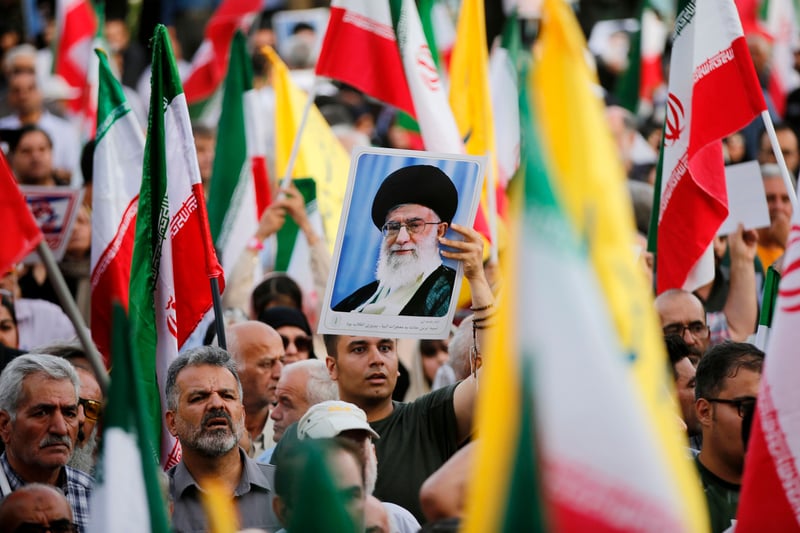
(250625) -- TEHRAN, June 25, 2025 (Xinhua) -- People celebrate the ceasefire between Iran and Israeal at Enghelab Square in Tehran, Iran, on June 24, 2025. The ceasefire was declared on Tuesday. (Xinhua) Xinhua News Agency / eyevine
Tensions between Iran and the United States are once again escalating, raising fears of a wider conflict in the Middle East. Iran’s Supreme Leader Ayatollah Ali Khamenei has warned that any direct military action by Washington would not remain contained, but would instead ignite a regional war with far-reaching consequences. His remarks come amid increased US military activity in the region, renewed threats from President Donald Trump, and lingering fallout from widespread protests inside Iran.
The warning underscores how fragile the geopolitical balance has become, as both sides harden their rhetoric while leaving the door open—at least publicly—to diplomacy. For regional allies, global energy markets, and international policymakers, the standoff represents one of the most significant security risks in the world today.
Khamenei Issues Stark Warning to Washington
Speaking through Iran’s state media, Ayatollah Khamenei made it clear that Tehran views any potential US attack as a direct threat not only to Iran, but to regional stability as a whole. He emphasized that while Iran does not seek to initiate conflict, it would respond forcefully to any aggression.
According to Khamenei, US military posturing and repeated threats are designed to intimidate Iran’s population. However, he insisted that such tactics would fail. He stated that the Iranian people would not be frightened or provoked into submission by the presence of American warships or by public warnings from US leadership.
Iran’s message was unambiguous: any attack on the country would be met with a powerful response, potentially drawing neighboring states and allied militias into a broader confrontation. This framing reinforces Tehran’s long-standing strategy of deterrence, which relies on signaling that the costs of military action would be unacceptably high for its adversaries.
Growing US Military Presence Raises Stakes
The warning comes as the United States continues to bolster its naval and military presence in the Middle East. In recent weeks, Washington has deployed additional warships, including an aircraft carrier, multiple destroyers, and littoral combat ships, to waters near Iran.
US officials have framed these deployments as defensive measures aimed at protecting American interests, allies, and shipping lanes. However, in Tehran, the buildup is widely interpreted as preparation for possible military action or as leverage to force Iran into concessions over its nuclear program and regional activities.
President Donald Trump has repeatedly threatened intervention if Iran refuses to agree to a new nuclear deal or fails to halt what Washington describes as violent repression of protesters. These statements, combined with visible military movements, have heightened anxiety across the region and increased the risk of miscalculation.
Nuclear Negotiations Still Possible, Iran Says
Despite the heated rhetoric, Iranian officials maintain that diplomacy has not been ruled out. Tehran has reiterated its willingness to engage in what it describes as “fair” negotiations with the United States and other world powers.
However, Iranian leaders have drawn a clear line regarding their defensive capabilities. They argue that any agreement must respect Iran’s right to self-defense and must not impose restrictions on its missile program or regional security posture. From Tehran’s perspective, these capabilities are essential deterrents against external threats.
This position highlights one of the core obstacles to renewed diplomacy. Washington has consistently sought broader limits on Iran’s military activities, while Iran insists that such demands undermine its sovereignty. As a result, even as both sides signal openness to talks, the gap between their negotiating positions remains wide.
Domestic Unrest Adds Another Layer of Tension
The international standoff is unfolding against the backdrop of recent unrest inside Iran. Protests that began in late December over economic grievances quickly evolved into the most serious political challenge the Islamic Republic has faced in decades.
Although demonstrations have largely subsided following a heavy crackdown, the episode has left deep scars. Iranian authorities describe the protests as a foreign-backed attempt to destabilize the country, while human rights groups paint a far darker picture of widespread repression.
Official figures put the number of deaths related to the unrest at just over 3,000. Independent human rights organizations, however, claim the toll is significantly higher, citing thousands more fatalities. These discrepancies have fueled international criticism and added to pressure on Tehran from Western governments.
Ayatollah Khamenei has characterized the protests as a coordinated “sedition” or coup attempt aimed at undermining the foundations of the state. This narrative reinforces the leadership’s view that Iran is under siege not only militarily, but politically and economically as well.
Risk of Regional Escalation Remains High
Iran’s warning that a US attack would trigger a regional conflict reflects the complex web of alliances and rivalries across the Middle East. Tehran maintains close ties with armed groups and political allies in countries such as Iraq, Syria, Lebanon, and Yemen.
In the event of a direct confrontation with the United States, Iran could leverage these relationships to respond asymmetrically. That could include attacks on US bases, allied infrastructure, or key shipping routes, potentially dragging multiple countries into the conflict.
Energy markets would also be at risk. Any disruption in the Persian Gulf or nearby waterways could affect global oil supplies, driving up prices and impacting economies far beyond the region. For this reason, even the threat of escalation tends to ripple through financial and commodity markets worldwide.
Strategic Messaging and Deterrence on Both Sides
Both Washington and Tehran appear to be engaged in a high-stakes game of deterrence. The United States uses military deployments and public warnings to signal strength and resolve, while Iran counters with rhetoric emphasizing resilience and retaliation.
Each side insists it does not want war, yet both continue actions that raise tensions. This dynamic increases the risk that an incident—whether accidental or deliberate—could spiral out of control. History has shown that conflicts often begin not with formal declarations, but with misunderstandings or isolated clashes that escalate rapidly.
For regional allies and international observers, the challenge lies in preventing such a scenario while encouraging meaningful dialogue. Diplomatic channels, even when strained, remain crucial for managing crises and avoiding unintended consequences.
Conclusion: A Fragile Moment for Middle East Stability
Iran’s warning of a regional war if the United States attacks underscores just how precarious the current situation has become. With heightened military deployments, unresolved nuclear negotiations, and lingering domestic unrest, the margin for error is dangerously thin.
While both sides continue to speak of diplomacy, their actions suggest deep mistrust and competing strategic goals. Whether this standoff leads to renewed negotiations or further escalation will depend on decisions made in Washington and Tehran in the coming weeks.
For now, the Middle East remains on edge, as the world watches to see whether confrontation or compromise will shape the next chapter in US-Iran relations.
About The Author