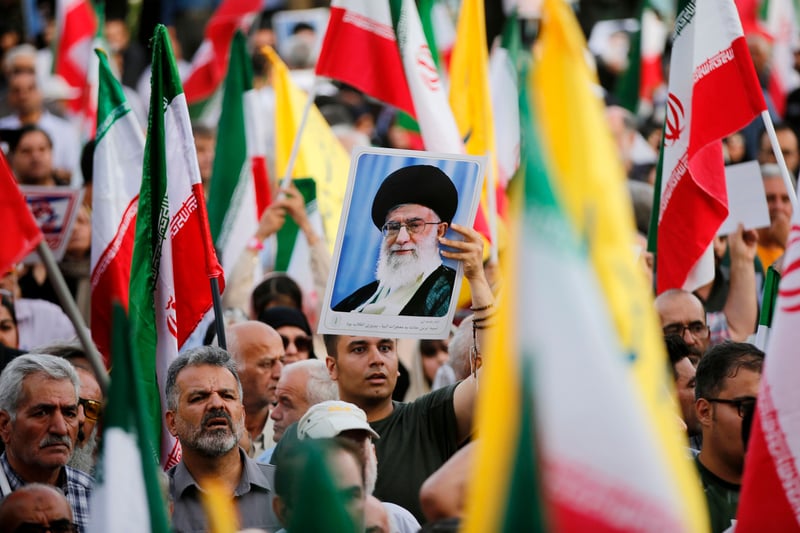
(250625) -- TEHRAN, June 25, 2025 (Xinhua) -- People celebrate the ceasefire between Iran and Israeal at Enghelab Square in Tehran, Iran, on June 24, 2025. The ceasefire was declared on Tuesday. (Xinhua) Xinhua News Agency / eyevine
Introduction: A Regime Under Dual Pressure
Iran’s ruling establishment is facing one of the most precarious moments since the founding of the Islamic Republic in 1979. According to multiple current and former officials, the country’s leadership is increasingly alarmed that a limited U.S. military strike could act as a catalyst for renewed mass protests—potentially spiraling into an existential threat to the regime itself.
Behind closed doors, senior officials have reportedly warned Supreme Leader Ayatollah Ali Khamenei that the social contract between the state and its citizens has eroded dramatically following a violent crackdown on protests earlier this year. With public anger running deep and fear no longer acting as a deterrent, Iran’s leaders are said to believe that foreign military pressure could push an already volatile situation beyond their control.
Private Warnings to the Supreme Leader
In a series of high-level meetings, officials briefed Khamenei on what they described as a dangerous shift in public psychology. According to sources familiar with these discussions, the scale of violence used during January’s protests—the deadliest unrest since the Islamic Revolution—has fundamentally altered how many Iranians view the risks of dissent.
Officials reportedly told the supreme leader that the traditional tools of intimidation are losing effectiveness. Years of repression, combined with the recent bloodshed, have led many citizens to believe they have little left to lose. In this context, even a limited U.S. military strike could embolden protesters to return to the streets with greater determination and less fear.
One official described the concern bluntly: external pressure could transform scattered anger into a coordinated uprising capable of inflicting irreversible damage on the political system.
The Collapse of the “Fear Barrier”
A recurring theme in conversations among insiders is the idea that fear—long the regime’s most powerful instrument—has been shattered. Former and current officials alike describe a population that is no longer intimidated by the prospect of arrest, injury, or even death.
A former senior government figure said public outrage had reached unprecedented levels following the January crackdown. According to him, the psychological barrier that once kept people from confronting security forces has largely disappeared.
This shift marks a critical departure from previous episodes of unrest, where demonstrations often subsided once force was applied. This time, officials fear that violence may have hardened public resolve rather than suppressing it.
Why a U.S. Strike Is Seen as Especially Dangerous
Iran’s leadership appears particularly concerned about the symbolic and psychological impact of a U.S. attack, even if limited in scope. According to officials, such an action could be interpreted domestically as proof that the regime is vulnerable, undermining its image of strength and control.
One senior figure warned that Iran’s adversaries may be deliberately seeking to synchronize foreign pressure with domestic unrest. In this scenario, military action would not be intended to topple the government directly, but rather to ignite internal instability that could spiral into systemic collapse.
“If an attack happens alongside mass protests,” the official reportedly said, “the ruling system could fall.” This possibility, sources say, represents the leadership’s greatest fear.
Public Defiance Versus Private Anxiety
The reported internal discussions contrast sharply with Tehran’s defiant public rhetoric. Official statements continue to emphasize strength, unity, and readiness to confront both foreign enemies and domestic dissent.
However, the private warnings to Khamenei suggest a far more anxious assessment of the situation. The gap between public messaging and internal deliberations highlights the leadership’s awareness that its grip on power is more fragile than it appears.
Iran’s Foreign Ministry declined to comment on reports of these meetings, and officials have remained silent on how Khamenei responded to the warnings.
Changing Dynamics Since Previous Attacks
Notably, the fears surrounding a potential U.S. strike stand in contrast to public reactions during earlier military confrontations. When Israel and the United States conducted airstrikes against Iran’s nuclear facilities last year, the attacks did not trigger widespread anti-government protests.
Analysts and former officials argue that conditions have changed dramatically since then. The January crackdown, which left thousands dead or injured according to witnesses and rights groups, has fundamentally altered public sentiment.
Where previous foreign attacks may have rallied nationalist feeling, a new strike could now intersect with domestic rage, creating a far more volatile outcome.
Opposition Voices Warn of Systemic Collapse
Several opposition figures—many of whom were once part of Iran’s political establishment—have issued stark warnings to the leadership. They argue that public anger has reached a boiling point and that continued repression risks pushing the country toward chaos.
Former Prime Minister Mirhossein Mousavi, who has been under house arrest since 2011, released a rare statement suggesting the regime has lost its legitimacy. He described the bloodshed of January as a turning point that would not be forgotten or forgiven.
According to Mousavi, the protests reflect a clear rejection of the political system itself, not merely dissatisfaction with individual policies. His remarks underscore the depth of the crisis facing Iran’s rulers.
Economic and Social Grievances Fueling Unrest
Beyond political repression, analysts point to long-standing economic and social grievances that continue to fuel public anger. Iran’s economy has suffered from years of sanctions, mismanagement, and corruption, leaving many citizens struggling to afford basic necessities.
Unemployment, inflation, and a widening gap between wealthy elites and ordinary citizens have deepened feelings of injustice. For many Iranians, the system appears incapable of delivering either prosperity or meaningful reform.
These underlying issues mean that unrest is not merely reactive but structural. Even if protests temporarily subside, the conditions that sparked them remain firmly in place.
Risk of Escalation and Mass Violence
While the streets are relatively quiet for now, insiders warn that calm should not be mistaken for stability. Several officials fear that if protests resume under the shadow of foreign military action, demonstrators would be more aggressive and security forces more brutal.
One official predicted that any uprising during a U.S. strike would be met with unprecedented force. In his view, the combination of emboldened protesters and a threatened regime could lead to large-scale bloodshed.
Ordinary Iranians interviewed expressed little confidence that the authorities would show restraint. Many said they expected an even harsher crackdown if demonstrations returned.
Voices of Personal Loss and Resolve
For families affected by the January violence, the stakes are deeply personal. A Tehran resident whose teenage son was killed during the protests said demonstrators were simply seeking dignity and opportunity, only to be met with bullets.
He said that if the United States were to strike Iran, he would return to the streets—not out of loyalty to any foreign power, but to seek justice for his child. His words reflect a broader sentiment among grieving families who see no path forward within the current system.
Conclusion: A Nation at the Brink
Iran’s leadership is confronting a volatile convergence of internal fury and external pressure. According to insiders, officials fear that a single spark—such as a U.S. military strike—could ignite unrest on a scale not seen in decades.
The collapse of public fear, combined with deep economic hardship and political repression, has created a situation where traditional methods of control may no longer suffice. Whether diplomacy prevails or confrontation escalates, the coming months could prove decisive for the future of the Islamic Republic.
What remains clear is that Iran’s rulers are acutely aware of the danger—and uncertain whether they can contain it if events spiral out of control.
About The Author