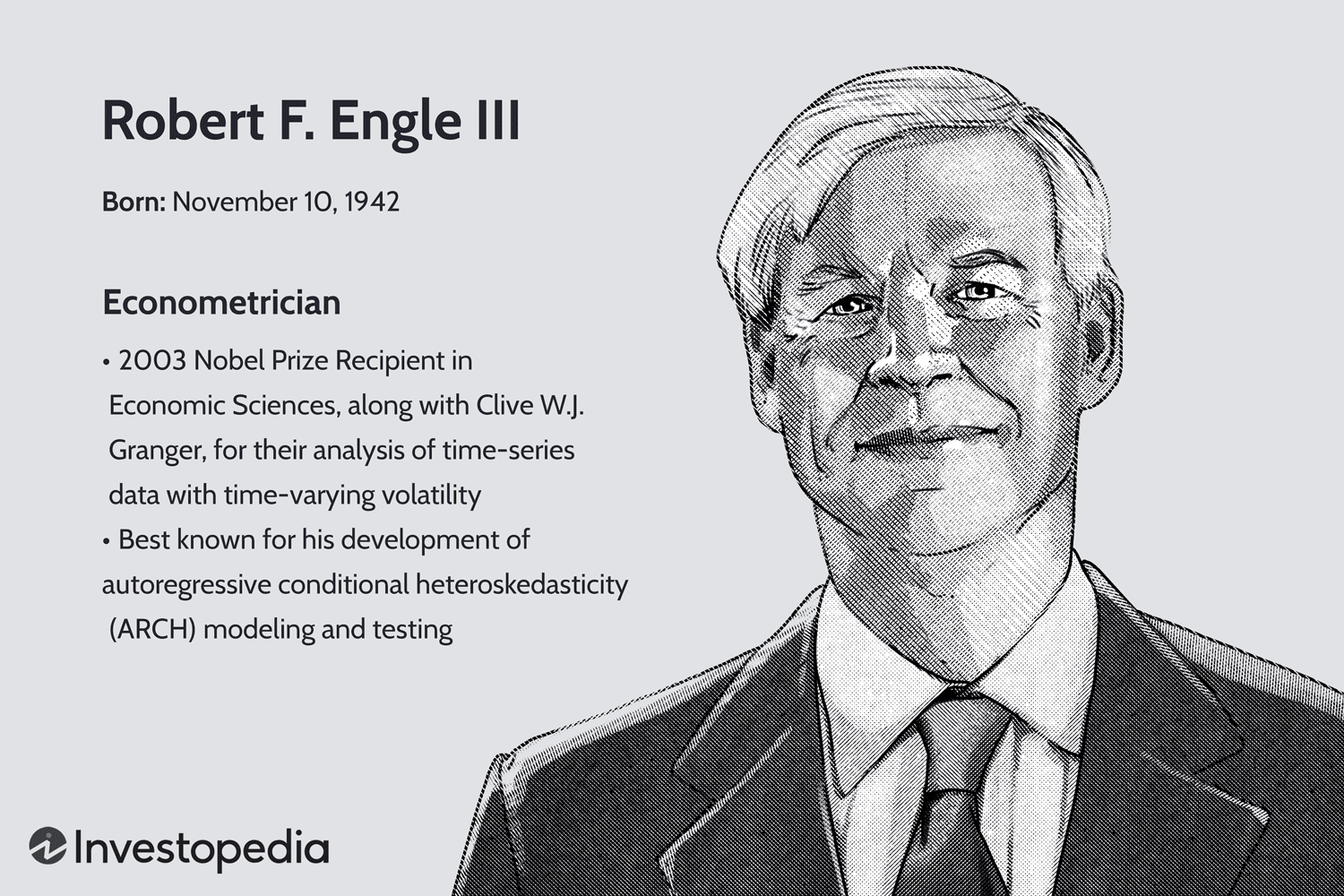
Modern financial markets rely heavily on quantitative models to measure risk, forecast asset prices, and manage uncertainty. One of the most influential contributors to this transformation is Robert F. Engle III, a pioneering econometrician whose work fundamentally reshaped how economists analyze volatility.
Awarded the Nobel Memorial Prize in Economic Sciences in 2003, Engle is best known for developing the Autoregressive Conditional Heteroskedasticity (ARCH) model. His research laid the foundation for modern financial econometrics and remains essential to risk management, derivatives pricing, and portfolio allocation strategies worldwide.
This article explains who Robert F. Engle III is, why he received the Nobel Prize, and how his groundbreaking ARCH model continues to shape global finance.
Early Life and Academic Background
Robert F. Engle III was born in 1942 in Syracuse, New York. His academic path was initially rooted in physics. While studying at Cornell University, he earned both a master’s degree in physics and a Ph.D. in economics. This interdisciplinary training proved crucial, as econometrics requires strong mathematical and statistical foundations.
Engle later held faculty positions at prestigious institutions, including the Massachusetts Institute of Technology, the University of California, San Diego, and New York University, where he became one of the leading figures in quantitative finance research.
His intellectual development was influenced by economist Ta-Chung Liu at Cornell, who guided Engle toward advanced econometric methods. This mentorship helped spark Engle’s interest in time-series analysis and the statistical modeling of economic fluctuations.
What Did Robert F. Engle III Win the Nobel Prize For?
In 2003, Engle shared the Nobel Prize with Clive Granger for their contributions to time-series econometrics. Engle specifically received the award for developing the ARCH model—Autoregressive Conditional Heteroskedasticity.
The Nobel Committee recognized ARCH as a breakthrough method for analyzing time-varying volatility in economic and financial data. Traditional models assumed constant variance over time. Engle demonstrated that volatility itself changes systematically and can be modeled statistically.
This insight was revolutionary.
Financial markets frequently experience “volatility clustering,” where periods of calm are followed by turbulence. Engle’s model allowed economists and financial analysts to quantify and predict these shifts rather than treating them as random anomalies.
The Nobel Committee noted that ARCH models are particularly useful in explaining financial market behavior, where large fluctuations often cluster together before returning to relative stability.
Understanding the ARCH Model
The ARCH model transformed econometrics by challenging the assumption of constant variance in time-series data. In standard regression models, the variance of the error term is assumed to be stable. Engle showed that this assumption often fails in financial markets.
Core Concept of ARCH
ARCH modeling assumes that:
- Volatility changes over time
- Current volatility depends on past squared error terms
- Periods of high variance are followed by high variance
- Periods of low variance are followed by low variance
In technical terms, the variance of the error term is modeled as a function of its own past values. If past shocks were large, future volatility is likely to remain elevated.
This approach allows analysts to detect volatility clustering and predict conditional variance—a crucial component in risk assessment.
Why Modeling Volatility Matters
Volatility measures how much asset prices fluctuate over time. It is widely used as a proxy for financial risk.
Higher volatility typically signals:
- Greater uncertainty
- Increased risk of large price swings
- Higher probability of extreme market events
Accurate volatility modeling is critical for:
- Portfolio risk management
- Value-at-Risk (VaR) calculations
- Derivatives pricing
- Capital allocation decisions
- Regulatory stress testing
Before ARCH, financial analysts lacked robust tools to systematically forecast volatility. Engle’s contribution made it possible to quantify risk dynamically rather than relying on static assumptions.
From ARCH to Financial Econometrics
Engle’s work extended far beyond the original ARCH framework. His research, along with that of Clive Granger, helped develop cointegration theory—another major breakthrough in time-series econometrics.
Cointegration allows economists to identify long-term equilibrium relationships between non-stationary time series. For example, two economic variables may drift in the short run but remain linked over the long run.
Together, these methods formed the backbone of financial econometrics, a field combining:
- Statistical modeling
- Economic theory
- Financial market analysis
Engle later co-founded the Society for Financial Econometrics, institutionalizing the discipline and encouraging advanced research in quantitative finance.
Applications of ARCH in Finance
ARCH and its extensions (such as GARCH models) are widely used in modern financial systems.
1. Risk Management
Banks and investment firms use volatility models to estimate potential losses under extreme scenarios. These estimates inform regulatory capital requirements and internal risk controls.
2. Derivatives Pricing
Options pricing models rely heavily on volatility assumptions. Since option values are highly sensitive to volatility, accurate modeling is essential.
3. Portfolio Optimization
Portfolio managers use volatility forecasts to adjust asset allocations dynamically. Higher predicted volatility may prompt hedging or rebalancing strategies.
4. Macroeconomic Analysis
ARCH models are applied to inflation, exchange rates, commodity prices, and interest rates to assess economic instability and cyclical risk.
Much of modern quantitative finance—including tools like Value-at-Risk and dynamic asset pricing—rests on Engle’s foundational contributions.
Engle’s Broader Contributions to Economics
Before developing ARCH, Engle conducted significant research in urban economics at MIT. He worked on econometric models of regional economic systems, applying statistical methods to urban planning and redevelopment.
His interdisciplinary approach—combining physics-level mathematical rigor with economic theory—allowed him to identify patterns others overlooked.
Even after receiving the Nobel Prize, Engle continued to influence policy debates and financial risk management practices. At NYU, he remained active in research on systemic risk measurement and global financial stability.
Lasting Impact on Global Financial Markets
Engle’s research has had enduring practical implications:
- Central banks use volatility models for policy analysis
- Investment firms integrate ARCH-type models into trading systems
- Regulators apply these techniques in stress-testing frameworks
- Academic researchers continue expanding volatility modeling techniques
The 2008 global financial crisis reinforced the importance of understanding systemic risk and volatility clustering. Tools derived from Engle’s framework played a key role in diagnosing market instability during and after the crisis.
His influence is embedded in nearly every sophisticated financial modeling system operating today.
Conclusion
Robert F. Engle III stands as one of the most influential economists in modern financial history. By developing the ARCH model, he fundamentally changed how economists understand and forecast volatility in time-series data.
His Nobel Prize-winning work provided the statistical foundation for financial econometrics and quantitative risk management. From banking regulation to derivatives pricing and portfolio management, Engle’s innovations remain central to contemporary finance.
In a world where markets are increasingly complex and interconnected, the ability to model volatility accurately is indispensable. Thanks to Engle’s groundbreaking contributions, economists and financial professionals possess the tools needed to navigate uncertainty with far greater precision and analytical rigor.
About The Author