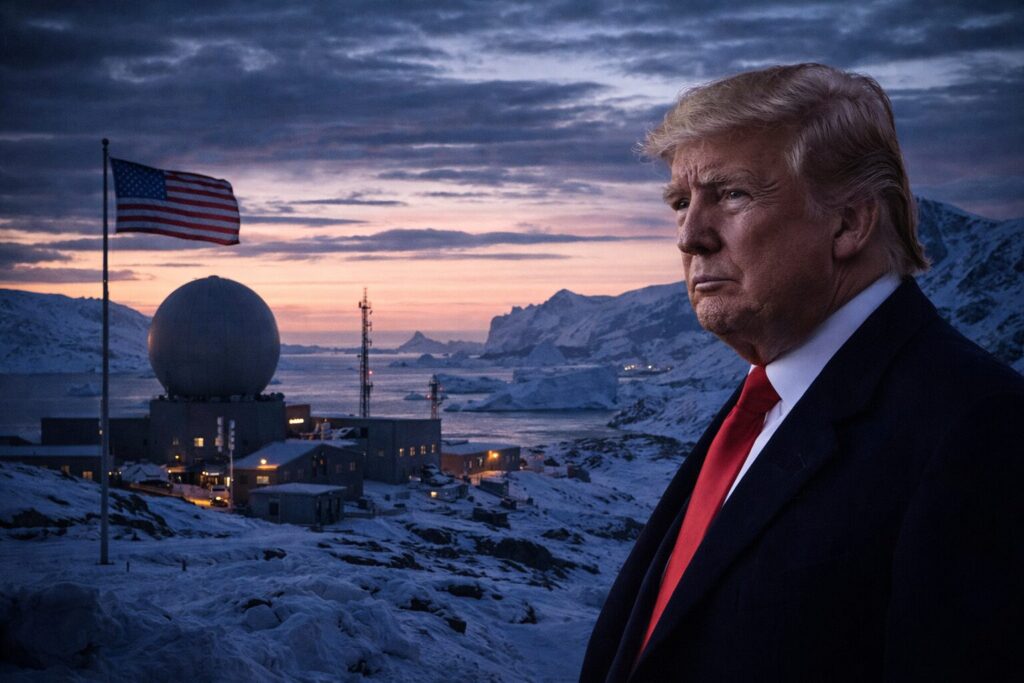
President Donald Trump intensified transatlantic tensions this week, signaling renewed trade confrontations and asserting U.S. claims over Greenland just days before the World Economic Forum in Davos. His remarks, delivered via media comments and social media posts, set the stage for a volatile period in U.S.–Europe relations and sent ripples across global markets.
Trump’s latest declarations include threats of massive tariffs on European products and critiques of allied nations’ policies, reigniting debates over trade, diplomacy, and geopolitical stability. Analysts are watching closely to see whether these tensions will escalate into significant economic disruptions or whether cooler heads will prevail.
Trump Doubles Down on Greenland
Speaking to reporters while returning to Washington, Trump joked that Davos would be “very interesting” and promised “a lot of messages” during his upcoming speeches. Central among these messages was his repeated claim that the U.S. will take control of Greenland, regardless of opposition from European governments.
In addition to Greenland, Trump floated proposals for tariffs as high as 200% on French wine if President Emmanuel Macron does not support a U.S.-led initiative concerning Gaza.
Trump’s remarks underscore his willingness to use trade tools aggressively to achieve strategic objectives, a stance that has already created friction with multiple European nations. Analysts warn that the combination of aggressive tariff threats and geopolitical posturing could have substantial economic consequences if the tensions escalate.
Davos and Diplomatic High Stakes
Trump’s presence at the World Economic Forum this week adds an extra layer of scrutiny. During the event, he is expected to:
- Deliver a keynote speech on Wednesday addressing U.S. foreign policy.
- Meet one-on-one with foreign leaders and CEOs.
- Engage in discussions surrounding transatlantic alliances and trade relations.
Meanwhile, European leaders are planning a European Council meeting in Brussels on Thursday to coordinate a response to the Greenland threat. The Council aims to review recent developments in transatlantic relations following an emergency summit held over the weekend.
The upcoming encounters are likely to determine whether diplomatic tensions ease or intensify, with significant implications for global markets and trade flows.
Tariff Risks and Economic Implications
Trump’s previously announced plan included a 10% tariff on goods from eight European nations starting February 1. European officials are reportedly considering $108 billion in retaliatory measures, raising concerns about a trade escalation.
Market observers and economists have warned of possible economic fallout:
- Capital Economics estimates that new tariffs could push the UK toward recession.
- Eurozone GDP could decline between 0.2% and 0.5% if tariffs take effect.
- Financial markets could experience heightened volatility, particularly if tensions affect investor confidence in trade-dependent sectors.
Despite the potential economic costs, Trump has signaled that he is willing to move forward with his proposed measures. Analysts like Ed Mills from Raymond James note that uncertainty in U.S. tariff policy, once thought to be easing, is likely to persist throughout 2026.
European Response and Political Pushback
European leaders have already voiced concern about Trump’s approach:
- European Commission President Ursula von der Leyen described the U.S. moves as “a mistake,” emphasizing that trust between allies should carry tangible meaning.
- Despite European criticism, Trump expressed confidence that opposition would be limited, asserting that “they’re not going to push back too much.”
The tension underscores the fragility of transatlantic alliances, particularly in the face of unilateral policy moves and escalating trade rhetoric. Analysts caution that ongoing uncertainty may strain diplomatic and economic cooperation in coming months.
Market Perspectives and Investor Sentiment
So far, market participants have shown some desensitization to Trump’s threats, with investors increasingly factoring potential tariff risks into asset pricing. Capital Economics highlighted that the degree to which markets can weather this storm depends on the trajectory of U.S.–Europe relations.
Trade lawyers and policy analysts warn that while the average tariff rate was previously expected to decline in 2026, Trump’s statements indicate the potential for sudden, large-scale trade shocks. This environment increases risk for investors in Europe and globally, as uncertainty may affect equities, commodities, and currencies alike.
Edward Yardeni of Yardeni Research characterized the week as “one of those be-ready-for-anything weeks,” noting that developments with the Federal Reserve, Supreme Court decisions, and ongoing geopolitical tensions could all influence markets simultaneously.
Trump’s Social Media Escalation
In addition to public statements, Trump used Truth Social to release previously private communications from European leaders, including Mark Rutte and Emmanuel Macron. He emphasized that “there can be no going back” regarding Greenland, reinforcing his determination to follow through on threats.
He also criticized the United Kingdom over the Chagos Islands, labeling its plan to return the territory to Mauritius as “total weakness.” Such posts demonstrate that Trump is leveraging multiple channels to assert U.S. positions, signaling a willingness to escalate tensions publicly if necessary.
Implications for the Transatlantic Alliance
The combination of trade threats, political provocations, and strategic ambitions suggests that the coming days may test the resilience of the U.S.–Europe partnership. Economists at Capital Economics caution that even if markets remain relatively calm, the economic costs of prolonged trade disputes could be significant.
Key considerations include:
- Potential retaliatory tariffs from Europe affecting U.S. exports and global trade flows.
- Investor caution in European markets due to heightened uncertainty.
- Increased risk premium for companies exposed to cross-border trade.
Whether these tensions evolve into full-scale economic disruption or remain a geopolitical standoff will depend on diplomatic negotiations and the tone set by Trump’s interactions at Davos.
Conclusion: A Crucial Week for Markets and Diplomacy
President Trump’s statements on Greenland and new tariff threats mark a pivotal moment in U.S.–Europe relations. With the World Economic Forum underway and European leaders coordinating responses, the coming week may determine whether tensions escalate or stabilize.
For investors, businesses, and policymakers, the key takeaway is clear: uncertainty and volatility are likely to persist. Market participants will need to monitor developments closely, particularly for any signs that trade conflicts could materially impact the eurozone, the UK, and global financial stability.
Trump’s assertive posture serves as a reminder that geopolitical risk remains a critical factor for global markets in 2026, and that policy unpredictability can have far-reaching economic consequences.
About The Author