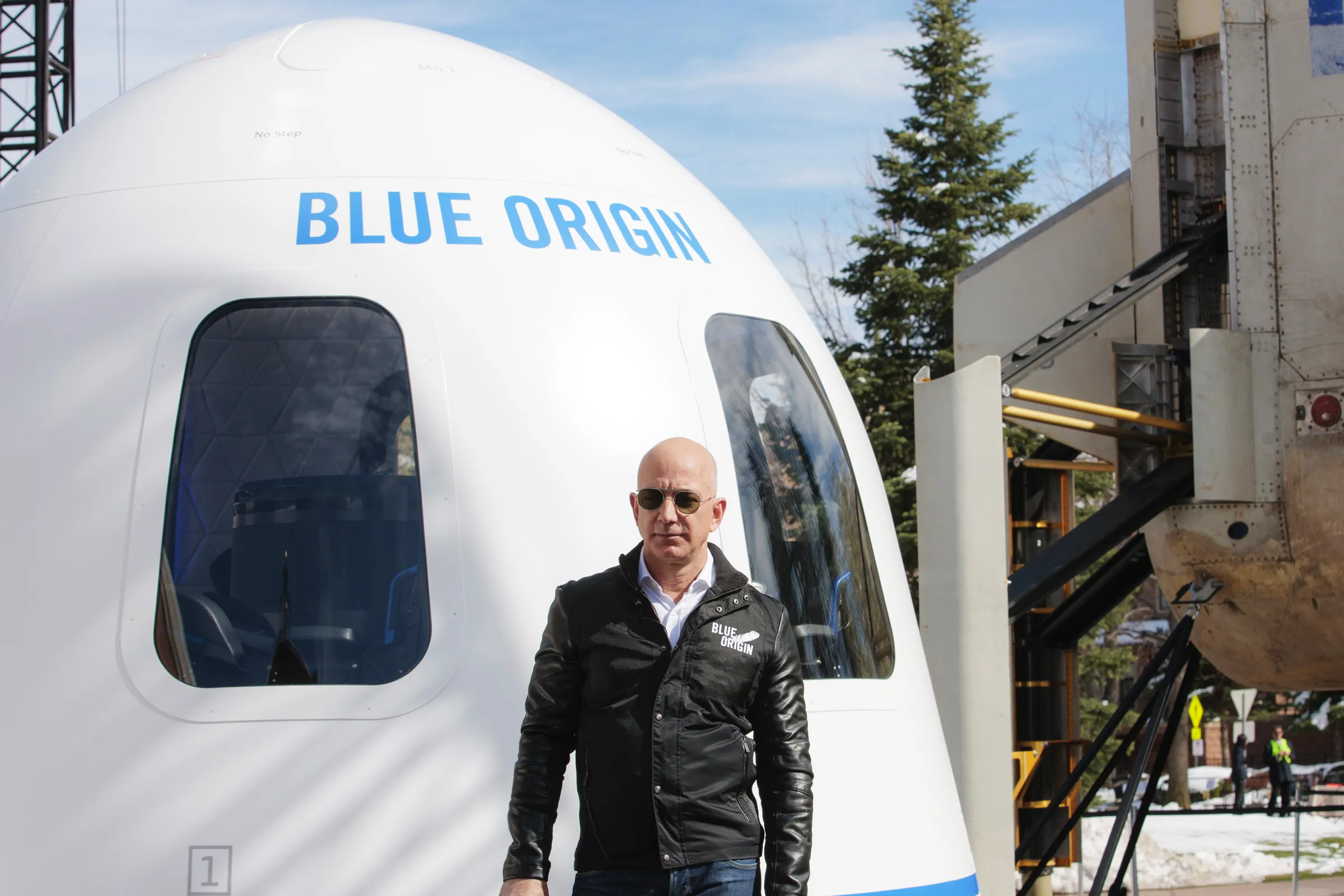
Jeff Bezos’ space company Blue Origin has been quietly developing technology to support artificial intelligence data centers in orbit, according to a report by the Wall Street Journal. The initiative has reportedly been underway for more than a year and reflects growing interest among technology leaders in moving computing infrastructure beyond Earth.
The report, citing a source familiar with the matter, suggests that Blue Origin is laying the technical groundwork required to operate large-scale AI computing systems in space. Such orbital data centers could address the mounting challenges faced by terrestrial facilities, including soaring energy consumption and heavy water usage for cooling.
At the same time, Elon Musk’s SpaceX is said to be pursuing a parallel strategy. An upgraded version of its Starlink satellite network could host AI computing payloads, according to people involved in related discussions. The technology has reportedly been referenced in connection with a potential share sale that could value SpaceX at as much as $800 billion.
Neither Blue Origin nor SpaceX provided immediate comment on the report, and the details could not be independently confirmed.
Interest in space-based data centers has increased as AI development accelerates and strains existing infrastructure on Earth. Massive data centers require vast amounts of electricity and water, prompting concerns about sustainability and long-term scalability.
Bezos publicly addressed the concept in October, predicting that gigawatt-scale data centers would eventually be constructed in orbit within the next 10 to 20 years. He argued that continuous access to solar energy in space—uninterrupted by weather or daylight cycles—could ultimately make orbital facilities more efficient and cost-effective than their terrestrial counterparts.
According to Bezos, large AI training clusters are particularly well-suited for space deployment, where constant solar power and stable conditions could significantly reduce operational constraints.
Meanwhile, Musk has recently disputed reports suggesting SpaceX is actively seeking funding at an $800 billion valuation, calling such claims inaccurate. However, separate reports indicate that SpaceX may pursue an initial public offering in 2026, potentially raising more than $25 billion and pushing the company’s valuation beyond $1 trillion.
As competition intensifies among major aerospace and technology firms, orbital data centers are emerging as a potential next frontier for AI infrastructure—one that could reshape how and where the world’s most powerful computing systems operate.
About The Author