⚡ A Quantum Leap in Energy Efficiency
Quantum supercomputers may soon become smaller, faster, and dramatically more energy-efficient than even the most advanced supercomputers on Earth.
Canadian startup Nord Quantique has unveiled a quantum bit (qubit) with built-in error correction, marking what its researchers call “a first in applied physics.”
This innovation could lead to a 1,000-logical-qubit machine small enough to fit inside a modern data center — while consuming 2,000 times less energy and solving complex problems 200 times faster than current supercomputers.
🧩 The Challenge of Quantum Stability
Quantum computers store and process information using qubits, which can exist in multiple states at once. However, these systems are extremely sensitive to environmental noise such as heat, vibration, and electromagnetic interference.
Traditional approaches use hundreds of physical qubits to stabilize one “logical qubit,” resulting in massive, power-hungry systems. Nord Quantique’s architecture changes that paradigm by embedding quantum error correction directly into a single qubit’s hardware — eliminating the need for external redundancy.
🔬 The Science Behind the Breakthrough
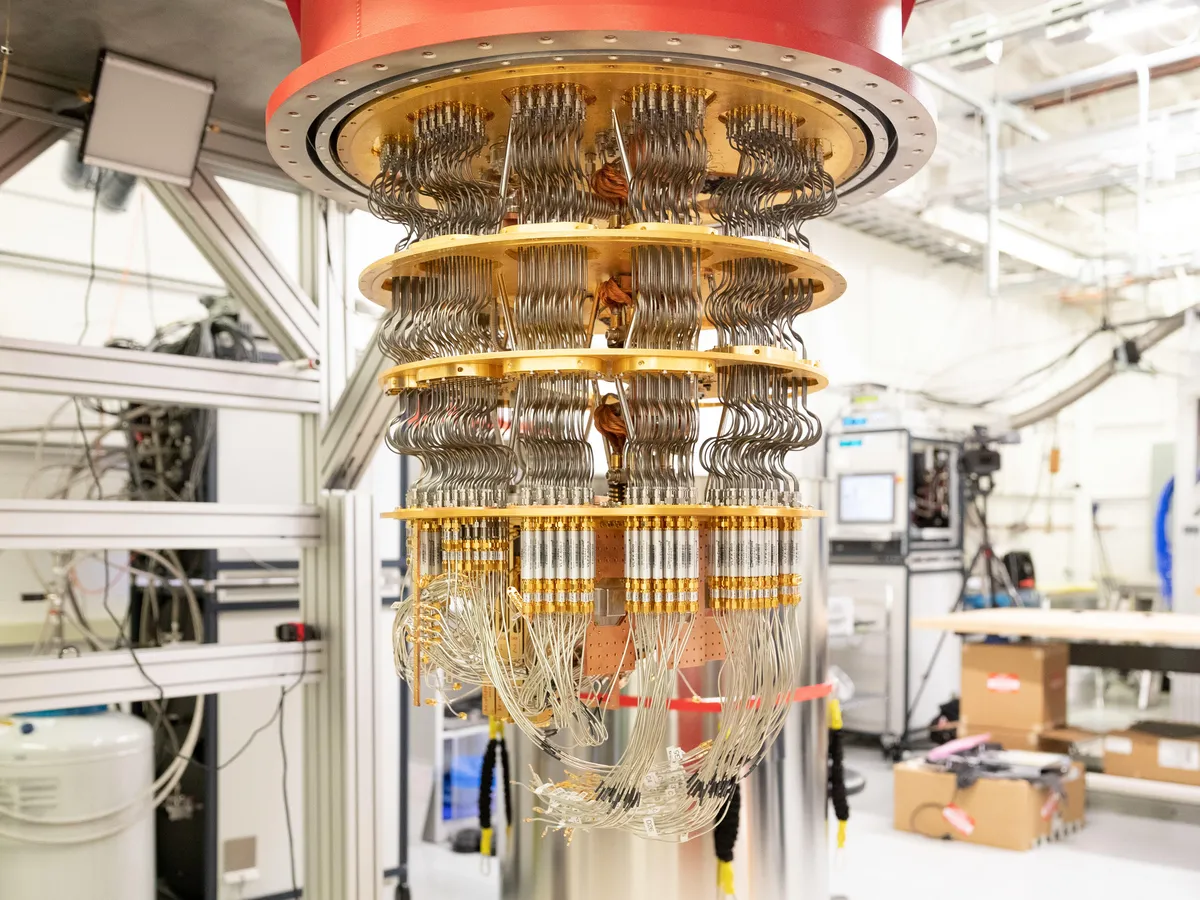
At the heart of Nord Quantique’s design is a superconducting aluminum cavity, or bosonic resonator, cooled close to absolute zero. Within it, light particles (photons) encode quantum data in multiple electromagnetic modes.
Each mode acts as a layer of redundancy — so if one fails, others can restore the correct state. This multimode encoding gives the qubit internal fault tolerance, creating a 1:1 ratio between physical and logical qubits — something previously thought impossible.
“Multimode encoding allows us to build quantum computers with excellent error correction capabilities — without the overhead of thousands of physical qubits,”
said Julien Camirand Lemyre, CEO of Nord Quantique.
🧮 Performance: From 9 Days to 1 Hour
Researchers estimate that a 1,000-logical-qubit machine based on this design would require only 20 square meters of space and could crack an 830-bit RSA encryption key in just one hour — consuming about 120 kilowatt-hours of energy.
For comparison, a supercomputer would take nine days and consume 280,000 kilowatt-hours for the same task.
That’s a 2,000x improvement in energy efficiency and 200x faster performance — a game-changing leap for high-performance computing (HPC) and cryptography.
🧱 Built-in Error Correction with Tesseract Code
To further enhance reliability, the system uses a bosonic code called Tesseract, which defends against quantum errors like bit flips, phase flips, and leakage — a particularly hard-to-fix issue where a qubit drifts outside valid states.
In tests, Nord Quantique’s qubit maintained stability through 32 consecutive rounds of error correction, with only 12.6% of results filtered out — an unprecedented level of fault tolerance.
🚀 The Road Ahead: From Prototype to Production
Nord Quantique aims to release a 100-logical-qubit system by 2029, followed by a 1,000-qubit commercial machine in 2031.
“Beyond their smaller and more practical size, our machines will also consume a fraction of the energy,”
Camirand Lemyre said. “That makes them ideal for HPC centers where energy efficiency is paramount.”
With built-in stability, scalability, and energy efficiency, Nord Quantique’s quantum architecture could mark the beginning of a new era — where quantum supercomputers become both practical and sustainable.
🏁 Key Takeaways
- Breakthrough: First physical qubit with integrated error correction
- Efficiency: Uses 2,000x less power and runs 200x faster than supercomputers
- Scalability: Targets 1,000 logical qubits by 2031
- Innovation: Multimode encoding + Tesseract code ensure fault tolerance
- Impact: Could transform AI, cryptography, and high-performance computing
About The Author