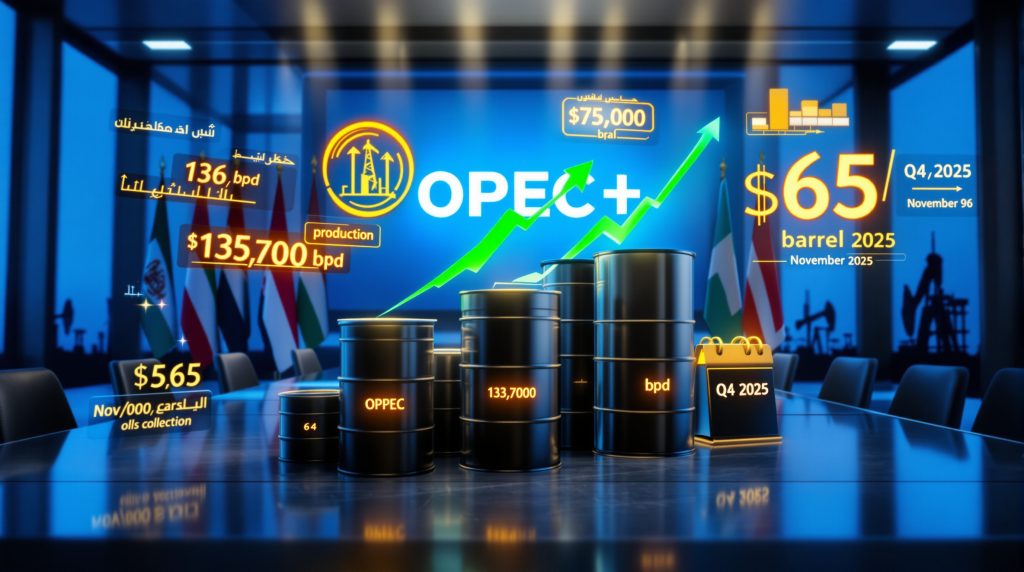
OPEC+ is expected to finalize an agreed-upon mechanism for evaluating the oil production capacity of each member state as the alliance prepares for a pivotal review that will determine output quotas beginning in 2027. Delegates say the group, led by Saudi Arabia, will formally approve the procedure during online meetings scheduled for Sunday.
The assessment of “maximum sustainable capacity” remains one of the most sensitive topics within the alliance. Some members hope to have recently added production capabilities officially recognized to secure larger future quotas, while others have historically struggled to meet their current output allowances. Establishing a clear standard would help align quotas with real-world production potential and strengthen the credibility of any future supply cuts.
OPEC+ Expected to Keep Output Levels Steady
Ministers from OPEC and non-OPEC partner countries are widely expected to maintain current production levels at Sunday’s biannual ministerial meeting. Analysts speaking to AFP said they anticipate no major policy shifts, given the high degree of uncertainty surrounding global oil demand and geopolitical developments.
Oil traders are closely monitoring negotiations aimed at ending the conflict in Ukraine—talks that could potentially open the door to renewed Russian crude exports. Such a scenario would significantly reshape global supply conditions.
Recent Output Trends: A Pause After Months of Increases
Since April, eight core OPEC+ members, including Saudi Arabia and Russia, have been gradually increasing output to reclaim market share amid rising competition from non-OPEC producers such as the United States, Canada, and Guyana.
However, the so-called V8 group announced earlier this month that they will halt further production increases during the first quarter of 2026. The pause reflects expectations of lower seasonal demand following a minor boost in December.
Given this backdrop, analysts such as Commerzbank’s Barbara Lambrecht expect the upcoming meeting to produce “no major new market drivers.”
Geopolitical Uncertainty Remains a Key Factor
Market specialists emphasize that the Ukraine conflict continues to influence price volatility. A ceasefire could reduce the risk premium currently inflating oil prices as attacks on energy infrastructure subside and sanctions potentially ease.
Conversely, if negotiations stall, U.S. President Donald Trump may be compelled to re-tighten sanctions on Russia’s oil sector, a move that could send prices higher, according to Arne Lohmann Rasmussen of Global Risk Management.
With so many unknowns, analysts broadly agree that OPEC+ will hold steady on its group-wide production decisions for now.
Capacity Review to Shape Future Quotas
During its previous ministerial meeting, OPEC+ committed to evaluating each member’s maximum sustainable production capacity—a benchmark that will form the basis of 2027 quota levels. This review is particularly important in light of shifting global oil dynamics and differing views among member nations.
Some analysts, including HSBC’s Kim Fustier, caution that discussions on revising baseline production levels may still be premature. She expects the alliance to defer deeper negotiations until 2026.
About The Author