What Are Greenbacks?
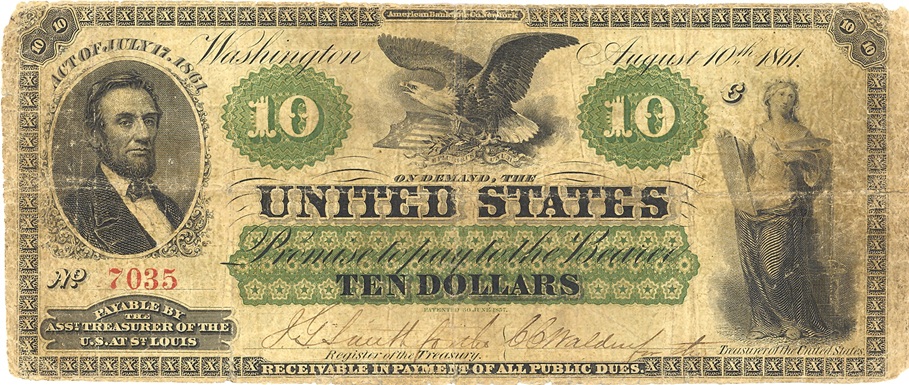
A greenback is a slang term for U.S. paper dollars, originally referring to the green-inked currency issued during the American Civil War. These early notes were printed to help finance the Union’s war effort, but because they were not fully backed by gold, their value fluctuated sharply, contributing to wartime inflation.
The first versions—known as demand notes—were issued in 1861–1862 to pay salaries and federal expenses. They were eventually replaced by standardized paper notes authorized under the Legal Tender Act of 1862, paving the way for the modern U.S. dollar.
Key Takeaways
- Greenbacks were introduced in the 1860s to help finance the Union during the Civil War.
- The nickname comes from the distinctive green ink printed on the back of the notes.
- Early greenbacks were not backed by gold, causing large swings in their value.
- Demand notes were the first version; they were replaced by paper notes under the Legal Tender Act.
- Greenbacks ultimately financed about 15% of the Union’s war costs, despite their instability.
How Greenbacks Emerged: A New Era of U.S. Paper Money
Before the Civil War, America’s financial system was chaotic. Foreign coins, private bank notes, and state-issued currencies circulated at varying values. Banks often printed more notes than they held coin reserves for, causing many notes to fall below face value.
By the early 1800s, the U.S. was ready to try national paper money again—but the Civil War accelerated the need.
Financing the Civil War
When the Union’s early war bonds failed to keep up with the massive costs of the conflict, the government authorized over $400 million in new legal-tender paper money.
Bankers were strongly opposed. They argued that:
- Paper money would drag the federal government into financial markets
- If the war went badly, the government could collapse under the debt
- The value of paper notes would depend entirely on public confidence
Despite the criticism, the Treasury issued the notes—soon nicknamed greenbacks.
Why the Notes Were Called “Greenbacks”
The name came simply from their appearance: the backs were printed in green ink.
The government guaranteed they could be used to pay both public and private debts—but crucially, they could not be exchanged for gold or silver.
This lack of convertibility made their value extremely unstable.
Fun Fact: Today, “greenback” is still used by forex traders as a casual nickname for the U.S. dollar.
Demand Notes vs. Paper Notes: What Changed?
Demand Notes (1861–1862)
- Issued to cover federal salaries and expenses
- Not considered legal tender
- Could be refused by private businesses
- Their value moved with the Union’s battlefield success
Paper Notes Under the Legal Tender Act (1862)
In February 1862, Congress passed the Legal Tender Act, replacing demand notes with official U.S. paper notes. These became the foundation of the country’s standardized currency system.
How Greenback Value Fluctuated During the War
Because greenbacks lacked gold backing, their value rose and fell depending on wartime events.
According to historian H.W. Brands:
- After Gettysburg, greenbacks briefly recovered in value
- In 1864, they hit their lowest point: 258 greenbacks = 100 gold
- After the war ended in 1865, they rebounded to 150 greenbacks = 100 gold
The Union’s large issuance—$400 million—also fueled inflation:
- 14% in 1862
- 25% in 1863
- 25% in 1864
Still, greenbacks covered roughly 15% of all war spending, making them crucial to the Union’s survival.
The Bottom Line
Greenbacks were the first widely used U.S. paper dollars, created during the Civil War to finance the Union’s war effort. Their green color, lack of gold backing, and fluctuating value make them one of the most fascinating chapters in American monetary history.
The Legal Tender Act of 1862 transformed greenbacks from temporary demand notes into the early version of modern U.S. currency—a legacy that continues today, as traders still refer to the dollar as the “greenback.”
About The Author