A New Path for Tesla’s Affordable EV
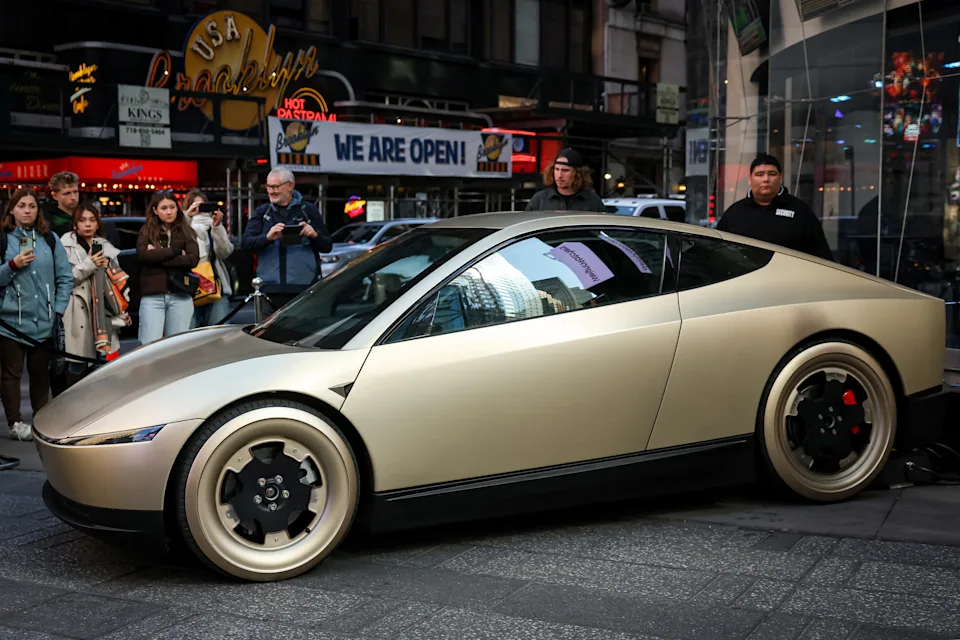
Tesla (NASDAQ: TSLA) may finally have found its solution to cracking the affordable EV market. According to company chair Robyn Denholm, the upcoming Tesla Cybercab—originally designed as a fully autonomous robotaxi—could be produced with minor tweaks, such as adding a steering wheel and pedals.
While that may sound small, it could have massive implications. Those additions could turn the Cybercab into Tesla’s long-rumored Model 2, a cheaper electric vehicle designed for the mass market.
From Robotaxi to $25,000 Tesla
Unveiled a little over a year ago on the Warner Bros. studio lot, the Cybercab was introduced as a driverless vehicle built using Tesla’s innovative “unboxed” manufacturing process. This new system aims to simplify production, use larger cast parts, and drastically reduce costs — potentially bringing the vehicle’s price down to between $25,000 and $30,000.
Tesla CEO Elon Musk has long envisioned a future where autonomous robotaxis dominate city streets. But while Musk once dismissed the idea of a low-cost EV, analysts and investors believe a budget-friendly Tesla could be the company’s most powerful growth catalyst yet.
Analysts See Opportunity in a Smaller Tesla
Market experts have been bullish on the idea of a cheaper Tesla for years.
Emmanuel Rosner, then an analyst at Deutsche Bank, described the potential Model 2 as a “volume play” that could boost sales, margins, and free cash flow. His successor, Edison Yu, echoed this sentiment, predicting that the vehicle—possibly dubbed the Model Q—could debut as early as 2026, though perhaps in select regions first.
“A smaller, cheaper Tesla is possible,” Yu wrote, “but it may have limited geographic scope at launch.”
Musk’s Change of Heart
Interestingly, Elon Musk wasn’t always convinced. In Walter Isaacson’s biography, Musk initially dismissed a $25,000 EV as “not that exciting.” But when Tesla design chief Franz von Holzhausen revealed two prototypes—one fully autonomous (Cybercab) and another with pedals and a steering wheel—Musk reportedly “loved the designs.”
That shift in mindset could pave the way for a dual strategy: a fully autonomous Cybercab and a manual, affordable Tesla Model 2 derived from the same platform.
Why the Cybercab Could Be Tesla’s Breakthrough
Tesla has already released cheaper versions of the Model 3 and Model Y, priced at $36,990 and $39,990, respectively, to offset the recent expiration of the U.S. federal EV tax credit. However, analysts doubt these models are cheap enough to unlock true mass-market demand.
That’s where the Cybercab-to-Model 2 transformation becomes crucial. By using the same modular manufacturing system, Tesla could:
- Reduce design and tooling costs
- Build both vehicles side-by-side
- Expand its lineup rapidly and profitably
In short, the Cybercab could become the template for Tesla’s next major leap — an EV affordable enough to compete globally while maintaining healthy margins.
The Road Ahead for Tesla
With Tesla’s ambitions in AI development and robotics, the company needs steady growth and strong cash flow to fuel its investments. Launching a mass-market Tesla under $30,000 could achieve exactly that.
If the Cybercab serves as the blueprint for a consumer-friendly Model 2, Tesla may not just dominate the high-end EV segment — it could finally crack the code on affordable electric mobility for millions worldwide.
About The Author