A Historic Moment in U.S.–Korea Relations
Former U.S. President Donald Trump wrapped up his five-day Asia tour with a major diplomatic victory — finalizing a long-awaited trade breakthrough with South Korea. Meeting with President Lee Jae-Myung in the historic city of Gyeongju, Trump announced that negotiations had reached “a pretty much finalized” stage after months of gridlock.
The agreement marks a significant turning point for both nations, easing tensions around tariffs and securing billions in new bilateral investments.
“We made our deal — pretty much finalized it,” Trump told reporters during a dinner with regional leaders at the Asia-Pacific Economic Cooperation (APEC) forum.
Inside the U.S.–South Korea Trade Agreement
Under the new arrangement, South Korea will invest $350 billion in the United States, a deal designed to stimulate U.S. manufacturing, shipbuilding, and infrastructure.
Key details include:
- $200 billion in cash investments, paid in installments capped at $20 billion per year.
- $150 billion directed toward shipbuilding and industrial innovation, supporting Trump’s efforts to revitalize American industry.
- A 50/50 profit-sharing structure until initial investments are recovered.
- Oversight by an investment committee led by U.S. Commerce Secretary Howard Lutnick, ensuring commercial viability.
South Korean officials praised the breakthrough, noting “dramatic progress” made in the final hours of negotiation.
“Prospects were not bright even last night,” said Kim Yong-beom, South Korea’s presidential policy chief. “There was dramatic progress on the day.”
A Turning Point for Global Trade Policy
The deal helps Seoul avoid steep U.S. tariffs on Korean imports — a major concern for Asia’s fourth-largest economy. It also boosts Trump’s standing ahead of his highly anticipated meeting with Chinese President Xi Jinping in Busan.
Trump hinted that discussions with Xi could lead to a broader easing of U.S.–China tariffs, particularly those linked to the fentanyl precursor chemical trade.
“I think we’re going to have a very good outcome for our country and for the world,” Trump said aboard Air Force One before arriving in South Korea.
According to reports, the U.S. may halve the current 20% levies on Chinese imports if Beijing agrees to tighten restrictions on fentanyl-related exports.
Xi Jinping Meeting Could Redefine U.S.–China Relations
Beijing has responded cautiously but positively, saying the summit could “inject new momentum into U.S.–China relations.” Chinese officials suggested that both nations are ready to work toward “positive outcomes” that would stabilize global markets.
Markets have already reacted favorably. Following news of the U.S.–China negotiation framework, global stocks surged to record highs, buoyed by hopes of a tariff truce and renewed cooperation.
Meanwhile, China signaled a thaw by purchasing its first U.S. soybean cargoes in months, a move seen as an olive branch ahead of Trump’s talks with Xi.
The Gyeongju Welcome: Gold Crowns and Diplomatic Theater
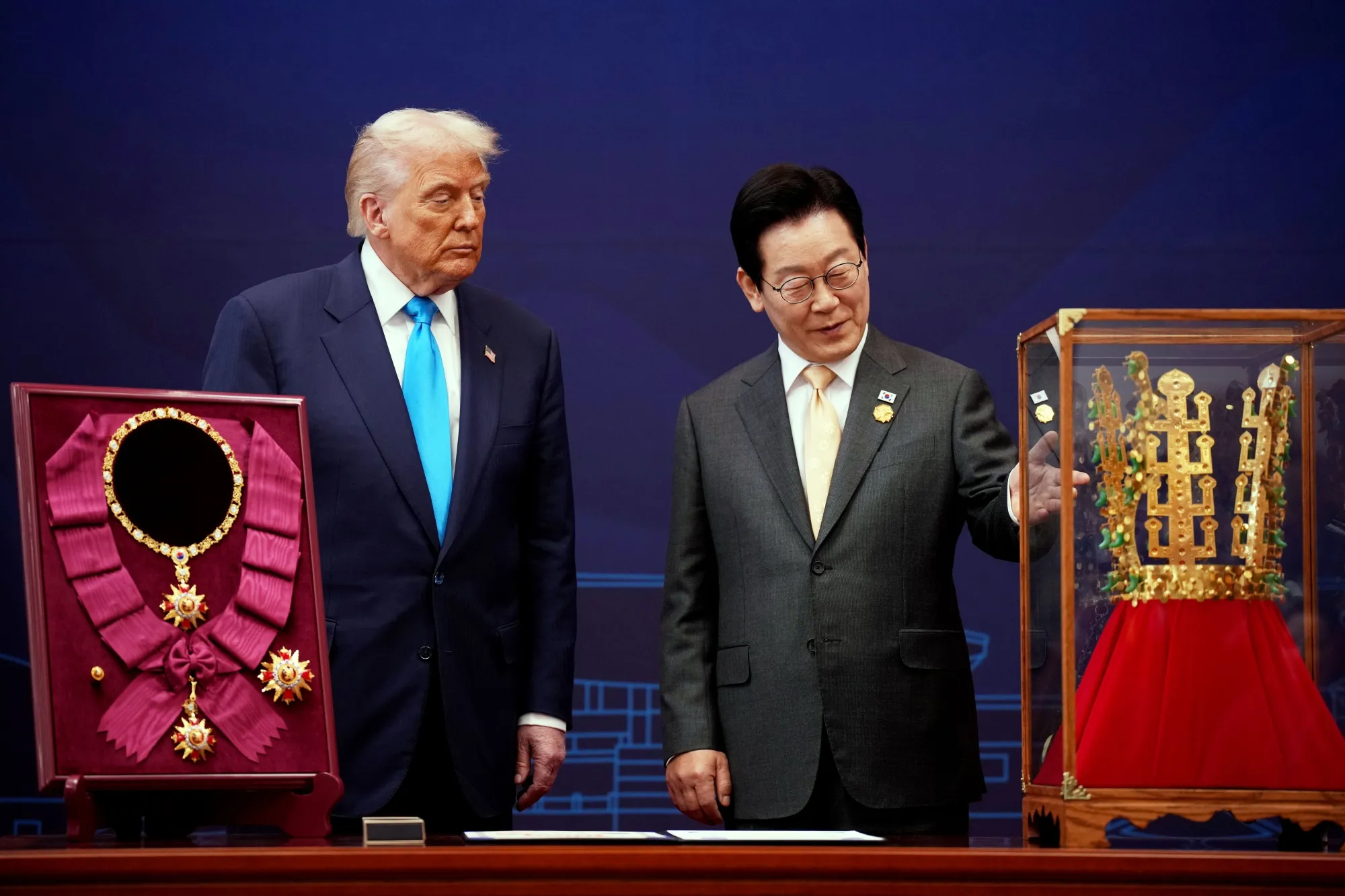
President Lee rolled out an extravagant welcome for Trump in Gyeongju. The U.S. leader received the “Grand Order of Mugunghwa”, South Korea’s highest civilian honor, and a ceremonial gold crown — symbols of respect and partnership.
During a luncheon featuring a “golden dessert,” Lee pledged to increase South Korea’s defense budget and asked the U.S. to allow nuclear fuel reprocessing to power long-range submarines. The request highlights Seoul’s ambition to strengthen surveillance capabilities against North Korea and China.
“We’ll help straighten out South Korea’s problems with the North,” Trump said, emphasizing ongoing U.S. support amid rising regional tensions.
Trade and Security: A Dual Focus
Trump’s visit came just hours after North Korea launched a nuclear-capable cruise missile, underscoring the delicate security landscape in East Asia.
While the missile test drew headlines, Trump dismissed it as a distraction, reaffirming that his focus was economic stability and strategic trade alliances.
Lee’s administration also confirmed that a memorandum of understanding outlining the new trade deal’s details will be released in the coming days, followed by a factsheet covering joint commitments on security and economic cooperation.
Protests and Political Pushback
Despite the diplomatic pomp, not everyone in South Korea was celebrating. Hundreds of protesters gathered outside the APEC summit venue, accusing Trump of strong-arming smaller economies into deals favoring U.S. interests.
“World leaders are flattering Trump just to persuade him to lower U.S. tariffs by a few percent,” said Kwon Young-guk, a former presidential candidate from a left-wing opposition party. “It’s absurd.”
Police clashed with demonstrators near Gyeongju’s central square, though no major incidents were reported.
What’s Next: From Gyeongju to Busan — and Beyond
Trump’s next stop is Busan, where he’s set to meet China’s Xi Jinping to finalize a potential tariff-reduction framework. Analysts believe this could lay the groundwork for a “Phase Two” U.S.–China trade accord, with ripple effects across global supply chains.
If successful, the twin agreements with South Korea and China could mark one of the most significant geopolitical wins of Trump’s post-presidency diplomacy — reshaping the balance of power across the Pacific Rim.
Why This Matters for Global Markets
- Global investment impact: South Korea’s $350B U.S. investment could strengthen U.S. industrial capacity and attract foreign capital.
- Tariff relief potential: Lower tariffs could cool inflation and restore trade flows disrupted since 2020.
- Market confidence: Wall Street responded positively to signs of thawing tensions, with Asian equities also climbing.
- Strategic shift: South Korea’s deepening defense ties with the U.S. could reshape regional security alliances.
Conclusion: A “Dramatic Progress” Moment for Trump’s Asia Policy
Donald Trump’s Asia trip concluded with a rare diplomatic double play — securing a complex trade deal with South Korea while preparing the ground for a potentially game-changing meeting with Xi Jinping.
While critics see the pomp and promises as political theater, the financial and strategic stakes are undeniably real. For now, both Washington and Seoul are celebrating what they call a “dramatic breakthrough” — one that could shape the future of trade and security in the Indo-Pacific for years to come.
About The Author