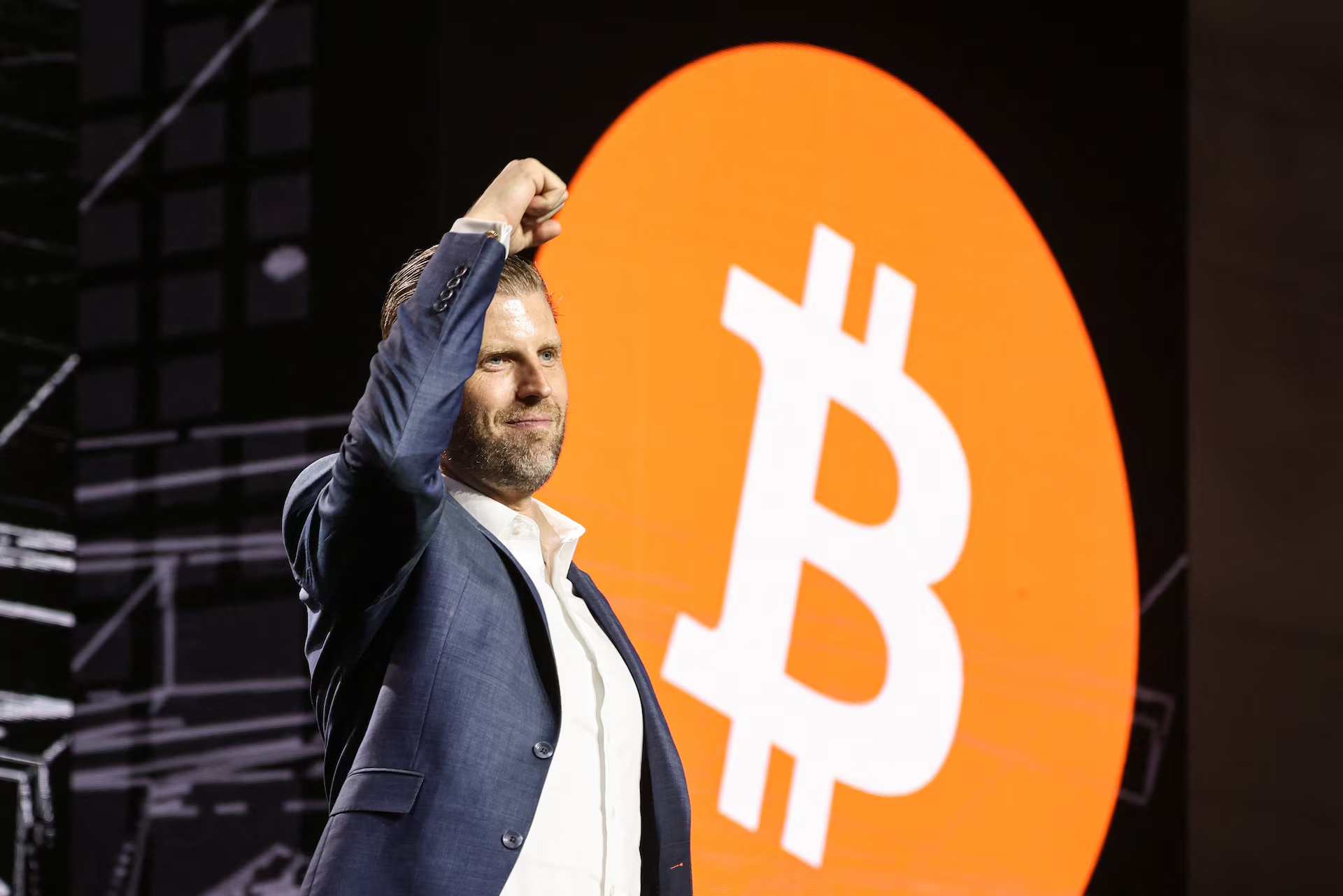
When Eric Trump walked into a luxury conference hall in Dubai earlier this year, few expected that his pitch for a new cryptocurrency venture would set off one of the most controversial financial stories of 2025. Standing before a room of investors and crypto entrepreneurs, the son of President Donald J. Trump spoke with the ease of a salesman who knew his audience.
He wasn’t selling condos or golf memberships — he was selling tokens. Specifically, “governance tokens” for a new Trump family crypto company called World Liberty Financial (WLFI). For a $20 million minimum investment, Eric promised, buyers could become part of the financial revolution — and the Trump brand would be its beating heart.
The offer worked. Within weeks, an obscure Emirati entity named Aqua1 Foundation poured $100 million into WLFI tokens. What followed was a flood of foreign money, opaque deals, and skyrocketing profits — turning the Trump family’s crypto empire into one of the most lucrative, and ethically fraught, stories in American political history.
The Birth of the Trump Crypto Empire
The Trump family cryptocurrency scandal didn’t start overnight. It began with a simple idea: if Trump’s name could sell steaks, hotels, and sneakers, it could sell digital coins.
World Liberty Financial launched in September 2024, touting itself as “the future of American finance.” The company’s pitch blended patriotism, profit, and populism. Promotional materials promised to “return power to the people” while offering investors a stake in a blockchain-based ecosystem that would rival traditional banks.
But despite the grand language, WLFI had no functioning platform, no proven technology, and no clear product. What it had was the Trump name, and that proved enough to open wallets worldwide.
In just six months, the Trumps earned more than $800 million from crypto sales, according to financial disclosures and court records reviewed by Reuters. Ninety percent of that income came from WLFI tokens and a second coin, the Trump-branded meme token, $TRUMP.
From Real Estate to Digital Assets
For decades, the Trump Organization thrived on real estate licensing, resorts, and golf clubs. But in 2025, crypto became its biggest revenue driver by far.
According to experts, the family’s income jumped seventeenfold year-over-year — a breathtaking transformation fueled by speculative hype and strategic political timing.
“The shift to crypto represents a massive pivot,” said Carter Davis, a finance professor at Ohio State University. “Even conservative estimates show an extraordinary concentration of income from digital assets.”
By mid-2025, the family’s crypto ventures dwarfed traditional income streams. Golf clubs brought in $33 million; real estate licensing, $23 million. But crypto alone brought in $802 million — all from coins that existed only on the blockchain and the family’s reputation.
Foreign Money and the Shadow Network
The money behind the Trump family’s crypto fortune isn’t just American. A Reuters investigation found that much of the $800 million came from overseas investors — many of them with legal or regulatory troubles.
Among the biggest buyers was Guren “Bobby” Zhou, a Chinese businessman under investigation in the U.K. for money laundering. Zhou reportedly met with Eric Trump in Dubai, where he was encouraged to invest at least $20 million in WLFI. Weeks later, Zhou’s affiliated company, Aqua1 Foundation, announced a $100 million purchase of tokens.
Zhou’s history — including millions in unpaid Chinese debts and an ongoing criminal probe — raised red flags. Yet no record shows the Trump family vetting these investors beyond basic identity checks.
The opaque nature of crypto wallets makes tracing the flow of money nearly impossible. Blockchain analytics firm Nansen found that 36 of the 50 largest WLFI token holders — controlling about $804 million — were likely foreign entities. Only a handful of wallets were linked to U.S. investors.
To ethics experts, this pattern looks less like a tech startup and more like influence laundering.
“These people aren’t investing in Trump tokens because of innovative technology,” said Kathleen Clark, a Washington University law professor specializing in government ethics. “They’re doing it because they want freedom from legal constraints and the kind of protection only a sitting president can deliver.”
“Legal but Unethical”
Technically, none of this breaks U.S. law. Unless the Trump sons explicitly offered access or political favors in exchange for investment, it’s all above board. But ethics experts are nearly unanimous: it’s a moral disaster.
“It’s legal but unethical,” said Richard Painter, the former chief ethics lawyer under President George W. Bush. “You have foreign nationals funneling money into businesses controlled by the president’s family while he sets national crypto policy. That’s textbook conflict of interest.”
The White House maintains that President Trump has no involvement in his businesses and that his assets remain in a trust managed by his children. But as the trust’s beneficiary, Trump will have full access to the profits once he leaves office.
In the meantime, the perception that buying Trump tokens could curry political favor has created a global feeding frenzy.
The Mirage of World Liberty Financial
World Liberty Financial’s official website paints a picture of a cutting-edge fintech ecosystem — a peer-to-peer lending app, a crypto-backed stablecoin (USD1), and a “freedom-driven” governance system.
But little of that exists. The promised lending platform remains vaporware. WLFI tokens offer no real ownership or profit-sharing rights. Even the company’s stablecoin is backed by another firm entirely.
WLFI holders can vote on minor governance decisions, but not on how profits are distributed. When the tokens began trading in September 2025, prices briefly spiked from $0.31 to $0.46 before plunging 65% within days.
Despite that collapse, the Trumps had already cashed in hundreds of millions through early sales. “Without the Trump name, you wouldn’t see World Liberty Financial raising this kind of money,” said Seoyoung Kim, a finance professor at Santa Clara University. “There’s no real innovation here — just brand power.”
Trump’s U-Turn on Crypto
It wasn’t long ago that Donald Trump called Bitcoin “a scam” and warned it would destroy the U.S. dollar. That changed dramatically once crypto became politically and personally profitable.
By late 2024, Trump had reinvented himself as crypto’s champion. His administration dismantled crypto enforcement units, relaxed banking guidance, and paused multiple SEC lawsuits against digital asset firms.
At the same time, his sons were touring Europe, the Middle East, and Asia to pitch WLFI tokens.
“Trump has effectively merged political power with speculative finance,” said one policy analyst. “His family is monetizing the same deregulation he’s championing from the Oval Office.”
The Foreign Connection: MGX, Binance, and the Stablecoin Deal
Perhaps the most controversial element of the Trump family cryptocurrency scandal involves a $2 billion deal tied to the World Liberty USD1 stablecoin.
In May, a state-owned investment company from Abu Dhabi, MGX, used USD1 stablecoins to buy a massive stake in Binance — the world’s largest crypto exchange.
The kicker? The Trump Organization owns 38% of an affiliate that earns interest from the securities backing USD1. Analysts estimate that this single transaction could deliver millions in annual income to the Trump family.
MGX’s chairman is Sheikh Tahnoon bin Zayed Al Nahyan, the UAE’s national security adviser and brother of the country’s president. Critics called it a direct violation of the U.S. Constitution’s Emoluments Clause, which bars presidents from accepting money from foreign governments.
Shortly after the MGX-Binance deal, Trump granted a presidential pardon to Binance founder Changpeng Zhao, who had served prison time for money laundering violations. The White House insists the events are unrelated.
Still, to many observers, the optics were undeniable: foreign money, presidential influence, and crypto profits colliding in plain sight.
The Roadshow: Selling “Freedom” Abroad
As the family’s crypto fortune swelled, Eric and Donald Jr. became global ambassadors of the Trump brand. Their “Trump Business Vision 2025” tour took them from Sofia to Singapore, where they pitched crypto investment as a patriotic act — a way to “restore American greatness through financial freedom.”
In Bulgaria, Don Jr. was greeted with red carpets and motorcades. The event was sponsored by Nexo, a crypto firm previously fined by the SEC for illegal securities offerings. Weeks later, Nexo became a sponsor of a Trump-owned golf tournament in Scotland.
By summer, Eric Trump and partner Zach Witkoff were headlining TOKEN2049 in Dubai, announcing new partnerships while railing against “corrupt banks.”
Everywhere they went, they mixed business with politics — and investors paid to be near the brand that now controlled both.
The Billion-Dollar Question
Between WLFI token sales, $TRUMP meme coins, and deals tied to USD1, analysts estimate the Trump family’s total crypto earnings could surpass $1 billion by year’s end — with an additional $11 billion in digital assets on paper.
But those numbers rest on a fragile foundation. WLFI’s price has plummeted. Binance’s credibility is shaky. And as foreign investors quietly offload tokens, questions grow louder: How sustainable is the Trump crypto empire — and how much of it depends on political power rather than market demand?
The answers may define not just the Trump legacy, but the future of financial ethics in American politics.
Conclusion: The Price of Power
The Trump family cryptocurrency scandal is more than a story about digital assets — it’s about the intersection of money, influence, and democracy.
World Liberty Financial isn’t just a crypto project. It’s a symbol of how political families can blur the lines between public service and private profit in the digital age.
If Trump’s name can mint millions in coins while he sits in the White House, what does that mean for the next generation of leaders — and for the meaning of “liberty” itself?
As one ethics professor put it: “World Liberty isn’t about financial freedom. It’s about how far you can stretch the rules before they break.”
About The Author